How do I advertise my business in my local area?
Two steps. First, be easy to find when someone already wants what you sell. Second, pay to get in front of people who don't know you yet, but only in the area you can actually serve.
Most advice online stops at social media. That's fine, but it leaves out the channels local businesses have long paid for: mail, the local paper, radio, sponsorships and outdoor ads. Each one reaches a defined area, and most publish a price. Here is what that looks like in published rates.
| Channel | How it's sold | Published example | Source |
|---|---|---|---|
| Google Local Services Ads | Per lead | No public price; you set a monthly budget | |
| Google Ads (search) | Campaign budget | You set a daily budget and can change it | Google Ads Help |
| Every Door Direct Mail | Postage per piece | $0.26 per piece (Retail) | USPS |
| Local radio | Per spot | $25 to $1,400+ per 30 seconds by market | FitSmallBusiness |
| Community newspaper | Per ad size | $90 (1/8 page, color) to $930 (full page, color) | Granby Drummer |
| Youth league sponsorship | Per season | $350 to $2,000 | Valley De Oro LL |
| Bus bench ad | Per month | $100 a month, plus $100 setup | Billings MET Transit |
| Self-serve digital billboard | Per 8-second play | From $0.01, no minimum | Blip |
| Junior poster billboard | Per 4 weeks | $300 to $750 | Blue Line Media |
| Mobile billboard truck | Per day | $500 to $900 static, 8 hours | The Rolling Ads |
| Garbage truck panel | Not on sale yet | Talk to us for pricing. No city is open yet. | Roadway |
Prices as published by each source. Sellers are labeled in the sources list. Your market will differ.
For a deeper look at outdoor prices alone, read outdoor advertising cost, which puts every outdoor format on one table.
Start where people search for you
Before you spend a dollar on reaching strangers, fix the place where ready buyers look. Google says creating a Business Profile and listing your business is free. It's what shows your hours, phone number, photos and reviews on Search and Maps. Fill it out completely. That's the one free step in this guide, and it's the one that makes every paid channel work better, because people who see your ad somewhere else may search your name before they call.
Then there are two paid ways to show up in search. Local Services Ads are Google's ads for local service businesses, shown in search results. Google says you only pay when potential customers get in touch through your ads, and you choose a monthly budget you can change any time. Google doesn't publish a price per lead on that page.
Google Ads search campaigns let you choose a daily budget for each campaign and change it whenever you want.
Search catches demand that already exists. It doesn't create much new demand. Someone whose water heater is fine isn't searching for a plumber. That's the job of the channels below: putting your name in front of people before they need you.
Direct mail to every address on a mail route
Mail lets you choose the exact neighborhoods you reach without buying a list. With the US Postal Service's Every Door Direct Mail (EDDM), you choose routes in its online tool, address the mailers to "Postal Customer", and they're delivered to every address on your selected routes. USPS lists EDDM Retail postage at $0.26 per piece, with 200 to 5,000 pieces per day per ZIP Code. The business-mail version runs as low as $0.259 per piece and has no volume limit.
Do the postage math before anything else. 1,000 pieces is about $260 in postage. 5,000 pieces is about $1,300. Design and printing come on top, and they vary a lot by printer and size, so get two quotes.
- Pick routes, not the whole town. Start with the routes closest to your shop or the neighborhoods where your best customers already live.
- Put one offer on it. A mailer that tries to say everything says nothing. One service, one reason to call now, one phone number.
- Make it trackable. Use a phone number or promo code that appears only on the mailer.
- Send more than once. One drop tells you very little. Plan for repeat drops to the same routes.
Local radio and newspaper ads
The US Chamber of Commerce's small-business site, quoting Business News Daily, lists local newspapers, radio spots, coupon books, movie theaters and sponsorships among the best ways to promote a brand to local consumers. Here is what two of those cost.
How much does local radio advertising cost?
It depends almost entirely on the market. One small-business publisher's guide puts a 30-second spot at as little as $25 in Topeka, Kansas and more than $1,400 in New York, with a national average of $327. The same guide estimates $200 to $5,000 a week to run a radio campaign, and $350 to over $3,500 to have an agency produce the spot. Ask the station for its rates by time of day.
A single spot rarely tells you anything. Ask for a package of spots over several weeks, and put a phone number in the ad that's easy to say and remember.
How much does a newspaper ad cost?
Community papers are often cheaper than people expect, and many publish their rate cards. Two real 2026 examples: the Granby Drummer, a community paper that prints ten issues a year, lists a full color page at $930 and a color eighth page at $90. It lists a circulation of 5,700 and says it's mailed to every residence, business and post office box in three Granby ZIP codes. The Marshall County Journal, a weekly in Britton, South Dakota, lists a full page at $1,147.50 and a 1/32 page at $35.86, with full color $100 extra.
A small paper that reaches every home in your town can be a better buy than a big metro daily that reaches mostly people outside your service area. Ask for the circulation by ZIP code before you compare prices.
Sponsorships and community events
Youth sports, school events and local festivals sell sponsorships, and many post their price levels. They put your name in front of families in a specific part of town, usually for a full season.
Two published 2026 examples. Valley De Oro Little League in Spring Valley, California lists levels from $350 for one 3 x 5 banner to $2,000 for multiple banners, a scoreboard name and a first pitch. North Boise Little League in Idaho lists a team sponsorship at $200, a single outfield banner at $650 and one street-facing banner at $5,000.
A sponsorship is goodwill first and advertising second. It's hard to track, so put a short web address or phone number on the banner and ask new customers how they heard about you. If you sponsor, show up. A banner at a field you've never visited does less than you'd hope.
Outdoor advertising options for a small budget
Outdoor advertising is anything people see while they're out: billboards, benches, buses, shelters, trucks. It's sold by location and time, which suits a business with a service area. Most formats come in smaller and cheaper sizes than the big highway boards people picture.
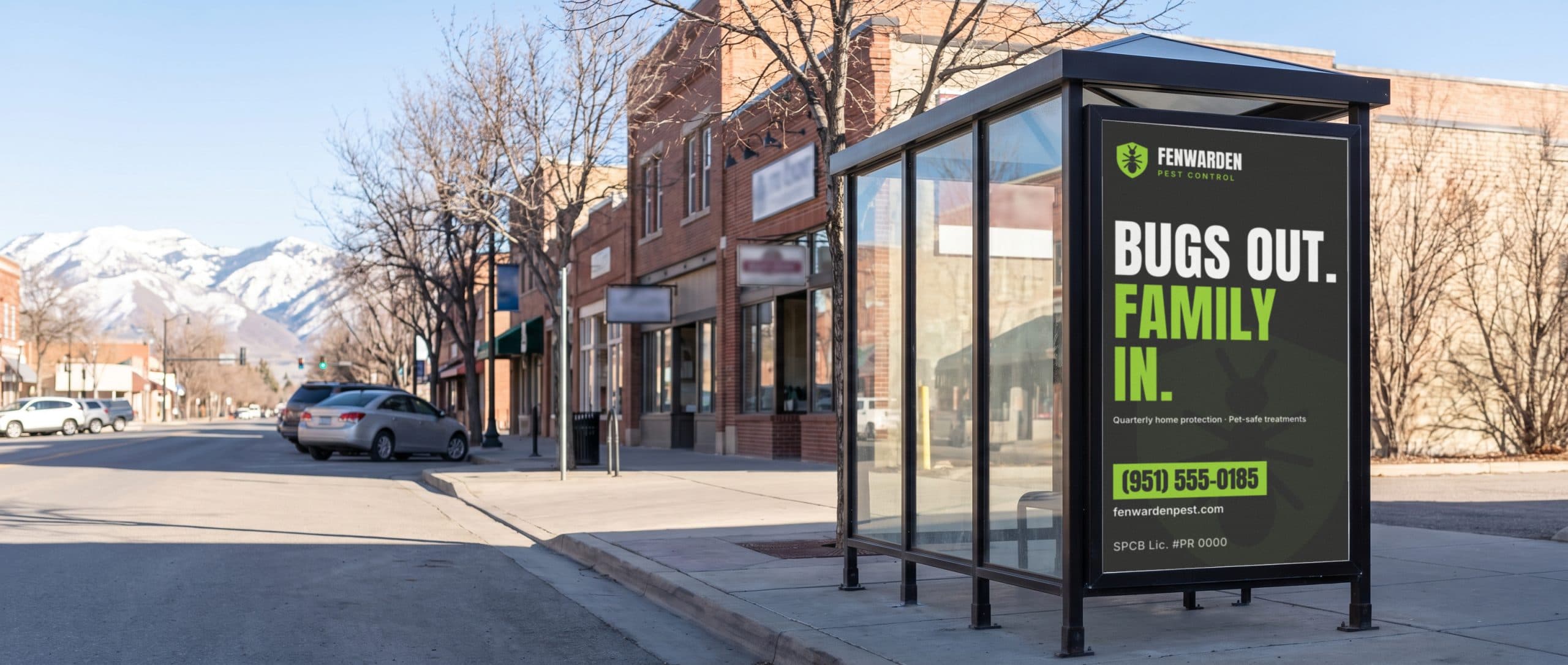
- Bus benches and shelters. Billings, Montana's transit agency lists a street-side bench ad at $100 a month, plus a $100 setup fee on the first invoice. Read bus bench advertising and bus shelter advertising.
- Inside and outside the bus. The same agency lists interior cards across its full fleet from $200 a month, and exterior bus ads from $100 a month. Read advertising on buses and bus advertising.
- Self-serve digital billboards. Blip sells single 8-second plays on digital boards starting at $0.01, with no minimum and no contract. You share the screen with other advertisers. Read digital billboard advertising.
- Smaller billboards. Blue Line Media lists junior posters at $300 to $750 per four weeks and posters at $750 to $4,000, with a minimum of $5,000 or more per market. Read cheap billboard advertising and billboard advertising.
- Mobile billboard trucks. One operator's guide lists static trucks at $500 to $900 a day for 8 hours, plus $300 to $800 to print the vinyl. Good for an event or an opening. Read mobile billboard trucks.
- Your own vehicles. A wrap on your work truck is paid for once, not monthly, and it goes wherever your jobs are. Read ads on trucks and vehicle wrap advertising.
- Garbage truck panels. A framed sign on the side of a city refuse truck. Talk to us for pricing. No city is open yet. More below.
Whatever the format, ask every seller the same three questions: the price per four weeks, the minimum, and whether printing and installation are included. For all formats side by side, start with the types of outdoor advertising.
When does outdoor advertising make sense for a local business?
Outdoor is one channel among several, not a replacement for being findable on Google. It tends to fit some businesses better than others.
- Good fit: you serve a defined area, like a roofer, plumber, HVAC company, dentist, lawyer or real estate agent; customers need you now and then, not every day, so you want your name familiar before they do; and you can run for several months.
- Weaker fit: a one-day sale, a business that serves the whole country, or a message that needs a paragraph to explain. A driver gets a few seconds.
If someone sees your name on a bench or a truck and searches for it later, your free profile is what they find. That's one more reason it comes first.
If you're in a trade, our pages for roofing, HVAC and plumbing companies go deeper. Industry guides cover law firm billboards, real estate billboards and roofing company billboards, including the license lines some ads must carry. For the effectiveness question, read are billboards worth it.
How much should a small business spend on advertising?
There's no number that fits every business, and we won't invent one. What matters more than the amount is that you can keep spending it long enough to learn something. Here's a way to set it.
- Know what a customer is worth. Roughly how much profit does a new customer bring you in the first year? That caps what you can pay to get one.
- Pick a monthly number you can hold for three months. One month of anything is noise. If you can only afford one month, pick a cheaper channel.
- Spend it on one or two channels, not six. Spread thin, no channel gets enough to show a result.
- Include production. Printing, design, vinyl and setup fees go into the budget, not on top of it.
- Track every channel separately. A phone number, promo code or landing page that appears only in that ad. Ask every new customer how they heard about you.
- Divide cost by customers. What the channel cost over three months, divided by the customers it brought in. Compare that with what a customer is worth.
Keep the channel that brings customers at a cost you can live with, and move the rest of the money to the next test. For an outdoor-specific version of these steps, read how to budget your first outdoor campaign, and for truck formats, what truck advertising costs.
Where garbage truck panels fit
Garbage truck advertising is a framed sign on the side of a city refuse truck, not a wrap. The truck is doing its normal city job, so you aren't paying for a truck to drive around just to carry your ad. In each city, every ad will be checked against that city's written ad policy before it runs.
On price: talk to us for pricing. Pricing is set city by city, and no city is open yet. There is no Roadway advertiser case study yet, and refuse trucks are not part of the industry's audited audience ratings, so any reach figure we show will be labeled as an estimate. Put a tracking number on the panel and count your own calls, like any channel above.
To see whether it belongs in your mix, read how garbage truck advertising works, join the list for your city, or see your ad on a garbage truck.
Sources
- Google: Business Profile
- Google (seller): Local Services Ads
- Google Ads Help (seller): Set your budget
- USPS: Every Door Direct Mail
- FitSmallBusiness (publisher): Radio advertising costs, updated June 17, 2025
- Granby Drummer (seller): 2026 print advertising rates (PDF)
- Marshall County Journal (seller): 2026 advertising rates sheet (PDF)
- US Chamber of Commerce CO: How to market your business locally, February 10, 2025
- Valley De Oro Little League (seller): 2026 spring season sponsorship
- North Boise Little League (seller): Sponsorship opportunities
- City of Billings, MET Transit: Advertise with MET Transit
- Blip (seller): Pricing
- Blue Line Media (seller): Billboard advertising rates
- The Rolling Ads (seller): Mobile billboard pricing guide 2026
Written by
Roadway Displays
Roadway Ad Network is a business line of Roadway Displays, which has built sign frames for refuse and recycling trucks since 1987. We make the frames and print the panels ourselves.
Published · Updated · About us