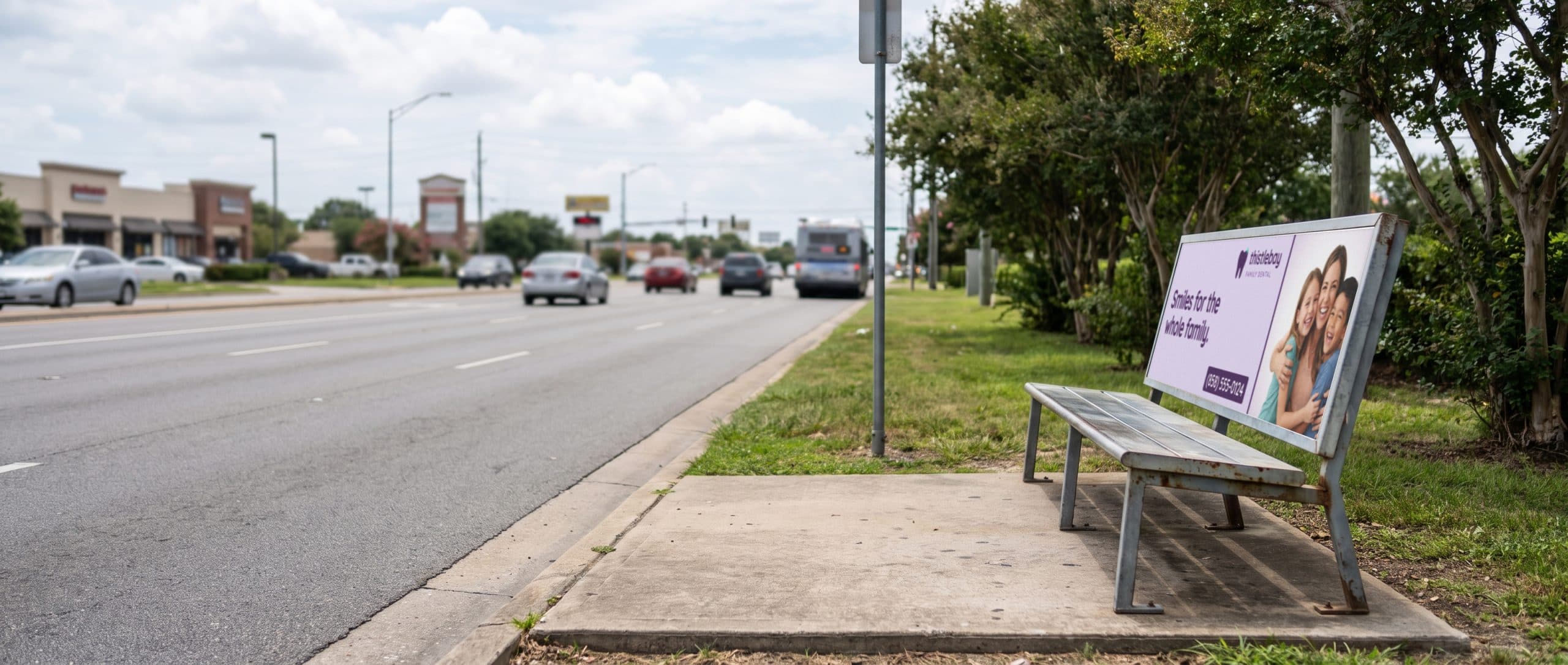
How much does a bus bench ad cost?
Bench ads are sold one bench at a time. Most published prices land in the low hundreds per bench for four weeks. The range is wide, though, because the people publishing these numbers are different kinds of sellers in different cities.
| Source | Published bench price | Unit |
|---|---|---|
| AdQuick (ad marketplace, estimate) | $150 to $450 nationally; $300 to $450 in top-10 markets; $100 to $250 in small markets | Per bench per four weeks |
| Blue Line Media (agency publication), Los Angeles | $300 to $500 | Per bench per four weeks |
| Blue Line Media (agency publication), national | $400 to $750, with a $5,000 or higher minimum per market | Per bench per four weeks |
| Dash Two (agency publication) | $300 to $1,500 | Per bench per month |
| MET Transit, Billings, MT (transit agency) | $100 street-side ad back; $150 double-sided | Per bench per month |
Prices as published by each source. Seller and agency estimates are not quotes. Check the date on each page.
Notice the units. AdQuick and Blue Line Media price per four weeks. Dash Two and the Billings agency price per month. Compare like with like before you pick a winner.
Printing is often on top. AdQuick says vinyl bench panels run $25 to $75 per unit to print and ship, and that some vendors include it. Billings adds a one-time $100 setup fee and $25 per bench to change the vinyl. Ask what a new panel costs before you plan to change the message.
Minimums can matter more than the unit price. Blue Line Media's $5,000 floor per market means one bench is not on the menu there. A city-run program like Billings will sell you one bench, if one is open.
Who owns bus benches, and who sells the ads?
A bus bench sits on a public sidewalk, in the public right of way. The city controls that space. So a bench with an ad on it almost always exists because the city or the transit agency signed a contract with a company. The company installs and maintains the benches. In return, it gets the right to sell the ad faces.
AdQuick describes it the same way: bench placements are handled through franchise agreements between the city or transit authority and a street-furniture vendor. That is why you rarely need a permit yourself. The company that holds the contract handles it.
Los Angeles: a public example
Los Angeles shows the model in its public records. The city's streets bureau says its Bus Bench Program keeps over 6,000 bus benches and 2,000 waste receptacles available and maintained at transit stops. The program runs through agreements with two companies, InSite Street Media and Creative Outdoor Advertising. Shelters are a separate program run with a different partner.
Earlier records show the city's rules travel with the contract. A council motion on the proposed citywide bench contract (Council File 11-1068) asked that new benches with ads follow local zoning codes, including limits on off-site advertising. The ads are a private business, but they sit inside public rules.
Transit agencies split it up too
Some transit agencies name a bench company on their own pages. San Diego MTS lists BriceHouse Outdoor for bus benches and a different company for shelters and buses. SacRT lists Clear Channel Outdoor for bus shelters and stop benches. Billings' MET Transit sells its own bench backs. And some agencies do not sell stop ads at all: the Riverside Transit Agency does not allow advertising on its shelters, and notes that Corona and San Jacinto run their own shelter programs.
The upshot: the bench seller is often not the bus seller. And the seller is whoever holds the contract in your city, which can change when the contract does.
Bench vs bus shelter vs bus ad
Benches, shelters and buses are all transit ads, but they work differently. A bench and a shelter stay in one spot. A bus moves. A shelter panel is bigger than a bench back and often lit. Here is how they line up.
| Format | Where | Typical unit | Full guide |
|---|---|---|---|
| Bench | The backrest of a bench at a bus stop | Per bench, per four weeks or per month | This page |
| Bus shelter | Poster panels on the walls of a bus shelter | Per shelter face, per month or four weeks | Bus shelter advertising |
| Bus exterior | Kings, queens, tails and wraps on the bus itself | Per ad per bus, per month or four weeks | Advertising on buses |
Units as used on the rate pages cited in each guide.
How to choose? Start with where your customers are. If they live and shop around a few corners, a bench or two near those corners does the job for the least money. If you want a bigger, lit panel where people stand and wait, price a shelter. If you want your name moving across a whole service area, look at the buses. Plenty of local businesses run more than one, and the sellers are often different companies, so you will make more than one call.
Sizes differ by market and bench maker. Dash Two calls 47 by 21 inches the standard bench panel. Blue Line Media lists 84 by 24 or 72 by 24 inches, depending on the market. Billings lists 6 by 2 feet. Get the exact spec from the seller before you design.
What are bus stop billboards called? Most sellers call them bus shelter ads or transit shelter panels. Geopath's transit glossary simply defines a bus shelter as a shelter for riders to wait for the bus. Benches, shelters and kiosks together are called street furniture.
Who bench ads suit
A bench is a neighborhood format. It stays on the same corner for the whole run, so the same people pass it on their way to work, school and the store. That fits businesses whose customers live or shop within a few miles.
- Local service businesses. Plumbers, roofers, HVAC and pest control companies that work a defined service area.
- Real estate agents. A name and face on the corners of the neighborhoods they sell in.
- Law firms. A firm name near the neighborhoods its clients come from. Attorney ads carry required lines; see law firm billboards.
- Restaurants and shops. A bench a block or two away can point people to the door.
- Clinics and dental offices. A steady name near the office, for the people who live around it.
Benches are not a citywide play. One bench only reaches one corner. Covering a whole metro takes many benches, and some sellers set a market minimum for that reason. If you want a few neighborhoods for a modest budget, benches are worth a call. To compare with other low-cost options, see cheap billboard advertising. For a full view of outdoor prices, see outdoor advertising cost.
What you can't put on a bench ad
Every bench ad passes through two sets of rules. The first is the city's or agency's ad policy, written into the bench contract. The second is the law that applies to your trade, which follows your ad onto any medium.
City policies vary, so there is no single list of banned topics. What is allowed is whatever the city's written policy says, and the company that holds the contract checks your art against it before it prints. Ask for the policy before you design, not after. It is usually short, and it saves you paying a designer twice.
Your trade's rules come along too. In California, licensed contractors must include their license number in all forms of advertising, and a bench back counts. California's lawyer advertising statute requires every ad to show the name of a responsible California lawyer or law firm and the city, town or county of an office; our law firm billboards guide covers them. If your industry is regulated, put the required line in the first draft so it does not get bounced at approval.
How to book a bus bench ad
Searching "bus bench advertising near me" mostly returns marketplaces and agencies. They can help, but the better starting point is your city, because the city decides who holds the bench contract.
- Find the contract holder. Check your city's streets or public works pages and your transit agency's advertising page. They often name the bench company.
- Ask for open benches near your ZIP. Benches sell one by one. Ask for a list or map of what is open, and for which weeks.
- Get the rate and the terms. Ask for the unit (month or four weeks), any minimum, and whether printing and install are included.
- Get the size and art spec. Panel sizes vary by city and bench maker.
- Send art for approval. The seller checks it against the city's ad policy.
- Print and install. AdQuick says most markets install bench ads within 5 to 10 business days of artwork approval.
- Get photo proof. Ask for a photo of each bench with your ad on it. Add a tracking number so you can count your own calls.
One more question to ask: how long is the contract holder's agreement with the city, and when does it end? Contracts end. When one is rebid, a new holder can mean new benches, new sizes and new prices. If you plan to run for a year, it helps to know.
If you are buying benches in several cities at once, a marketplace or agency can save you the calls. In one city, going straight to the contract holder is simpler.
Street furniture beyond benches
Street furniture advertising is any ad on a fixture in the public right of way. Benches and shelters are the common ones. Kiosks are the next. The Champaign-Urbana Mass Transit District, for example, sells digital space on more than 30 passenger information kiosks.
Programs keep growing. Los Angeles says its new shelter program, which began in 2024, will add more than 3,000 new bus shelters across the city over the next decade. Each new fixture comes with its own contract and its own ad rules. The pattern holds every time: city property, a contract, a written policy, and a company that sells the faces.
The same city model, on garbage trucks
A bench program is a city contract, an ad policy and local ad faces. Garbage truck advertising applies that same model to the city's collection fleet. Instead of a bench on one corner, it is a framed panel on a truck that runs residential routes on the city's schedule.
Cities have put ads on their refuse trucks. Columbus, Georgia's council approved a contract for it in 2021. Read more in can you advertise on garbage trucks?.
Ours is a framed sign, not a wrap. The printed panel slides out of the frame. The panel live area is 91 x 27 in, with two sides per truck. The printed panel swaps in under 30 seconds. A new message still goes through design, review and printing first. In each city, every ad will be checked against that city's written ad policy before it runs.
It fits as an addition to benches, not a replacement. Use it for areas where there are no benches with ads, or where the benches are sold out. Pick your city. See which areas its routes cover.
No city is open yet. See your ad on a truck, read how garbage truck advertising works, or tell us your city and we will write when it opens.
Sources
- AdQuick (ad marketplace, seller): Bus bench advertising guide
- Blue Line Media (agency publication): Los Angeles bus, shelter and bench rates
- Blue Line Media (agency publication): Bench advertising
- Dash Two (agency publication): Bus bench advertising
- City of Billings: Advertise with MET Transit
- StreetsLA: Better Bus Stops, Urban Transit Amenities Program
- Los Angeles City Clerk: Council motion, Council File 11-1068 (PDF)
- San Diego MTS: Advertising
- SacRT: Advertising
- Riverside Transit Agency: Bus and bus shelter advertising
- GRTC (Richmond, VA): Advertising rates, updated October 2024 (PDF)
- Champaign-Urbana MTD: Advertise
- Geopath: Transit glossary
- California Business and Professions Code section 7030.5
- California Business and Professions Code section 6157.2 (lawyer advertising)
- Columbus, Georgia city council minutes, April 13, 2021 (Resolution 111-21) (PDF)
Written by
Roadway Displays
Roadway Ad Network is a business line of Roadway Displays, which has built sign frames for refuse and recycling trucks since 1987. We make the frames and print the panels ourselves.
Published · Updated · About us