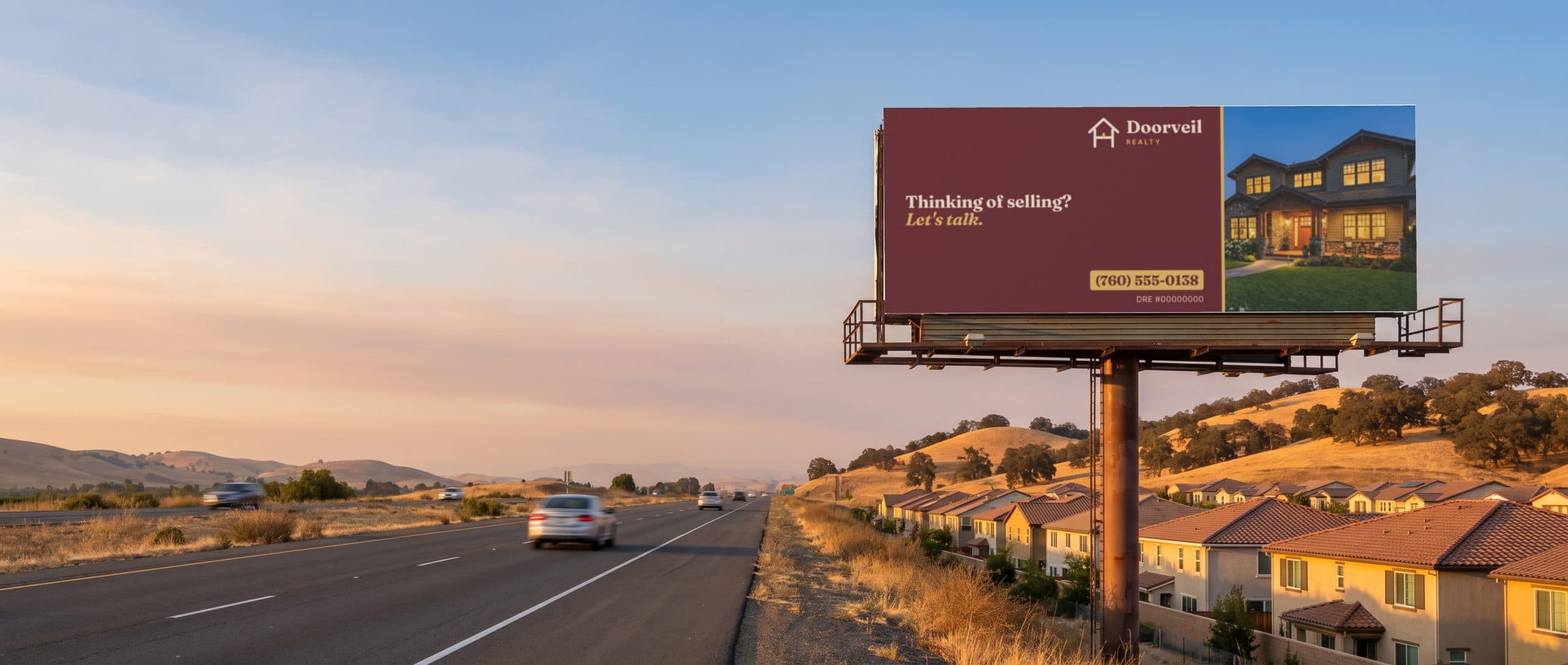
Do billboards work for realtors?
Nobody can answer that for you in general. There's no public dataset of real estate billboard results, and an agent's sales cycle is long. Someone may see your board for a year before they're ready to sell.
What a board or bench does is put your name in front of the same people again and again. In real estate that matters more than in most trades. A homeowner who decides to sell usually calls an agent they've heard of. If your name has been on the corner they drive past, you're on that short list.
That only works if it fits the rest of your marketing. A board in a part of town where nobody knows you, with nothing else behind it, is a hard bet. A board or a few benches in the area you already farm, next to your for-sale signs and mailers, does a clearer job. It reminds people of a name they've seen.
So the test is your own. Give the board a tracking number, ask every caller how they found you, and count listing appointments over several months. The tracking section below walks through it. For the wider question, read are billboards worth it.
Before you price a board, though, get the required lines right. An agent's ad isn't like a coffee shop's ad. California says what has to be on it.
What California's DRE rules require on a real estate billboard
Three pieces of law do most of the work: Business and Professions Code section 10140.6, the Real Estate Commissioner's regulation 10 CCR 2773, and the definition of a broker's identity in section 10015.4. The Department of Real Estate (DRE) also publishes plain-English advertising guidelines.
What the board must show
Section 10140.6(b)(1) says a licensee must disclose these on all solicitation materials intended to be the first point of contact with consumers:
- Your name. The name you're licensed under. If you legally changed your surname, you can keep using the former one as long as both names are on file with DRE.
- Your license identification number. Regulation 2773 spells it out as your eight-digit DRE number. If more than one licensee is named on the ad, each one's number goes on it.
- The responsible broker's identity. The name the broker is currently licensed under. Section 10015.4 says that does not include a fictitious business name or a team name.
- An NMLS number, if it applies. A licensee who is also a mortgage loan originator adds their NMLS unique identifier.
Section 10140.6(a) separately requires matter published in a newspaper, periodical or by mail to say you're doing work that needs a real estate license. Under 10 CCR 2770.1, words like "broker", "agent" or "Realtor" satisfy that, and one of them on a board costs nothing. Anyone can check a license in DRE's public license lookup.
Does a billboard count?
The statute's definition of solicitation materials includes ads "in print, or electronic media" and "other materials designed to solicit the creation of a professional relationship between the licensee and a consumer." Regulation 2773's list doesn't use the word billboard. It does include "any marketing or promotional materials" intended to get a consumer to contact you about a service that needs a license. DRE's guidelines list billboards as a form of real estate advertising. A board with your name and phone number exists to get people to call you, so the careful reading is to treat it as first point of contact material.
One exemption trips people up. Section 10140.6(c) and 2773(b) let "for sale", rent, lease, "open house" and directional signs skip the number if they show only the broker or no licensee at all. That exemption is written for those signs. A billboard isn't on that list.
Size matters too. Under 2773(a), if the ad is in written form, the license number can't be in smaller type than the smallest type used on the ad. On a billboard, that means your smallest line sets the floor for the DRE number.
Team names on a board
A team name has its own rules. Under section 10159.7 it has to include the surname of at least one team member plus "team", "group" or "associates", and it can't use words like "broker" or "brokerage". Under section 10159.6, any ad with a team name must show the team name and the name and license number of at least one licensed member. The responsible broker's identity has to be as prominent as the team name.
Keep it current
DRE's guidelines name billboards among ads that can last for months or years after they're made, long enough for the facts on them to change. If you change brokerages, change your business name or move offices, the board needs to change too, or it can become a misleading ad.
Not legal advice
This is a summary of public sources, not legal advice, and we don't review ads for legal compliance. DRE's guidelines are dated August 2020, before the 2022 amendment to section 10140.6, so read the statute for the current wording. Have your responsible broker sign off before a board goes up.
Rules that apply in every state
Two more rules apply wherever the board stands, in California or not. If you're a Realtor, the NAR Code of Ethics Standard of Practice 12-5 says you can't advertise real estate services or listed property in any medium without showing your firm's name in a reasonable and readily apparent way.
The second is federal fair housing law. HUD's rule at 24 CFR 100.75 makes it unlawful to publish an ad about the sale or rental of a dwelling that indicates any preference, limitation or discrimination because of race, color, religion, sex, handicap, familial status or national origin. The rule names billboards. It also covers words, photos and symbols on the ad, and selecting media or locations for ads in a way that denies particular segments of the housing market information about housing opportunities because of those traits.
Each state also has its own license-law rules for ads. If your board will be outside California, read your state's real estate commission rules before you print.
How much does a real estate billboard cost?
Billboard pricing doesn't change because the advertiser is an agent. The board, the market and the length of the run set the price. Blue Line Media lists these ranges per display per four-week period:
| Board | Per 4 weeks | Source |
|---|---|---|
| Junior poster (small) | $300 to $750 | Blue Line Media |
| Poster (medium) | $750 to $4,000 | Blue Line Media |
| Bulletin (large) | $1,500 to $30,000 | Blue Line Media |
| Digital bulletin | $3,500 to $25,000 | Blue Line Media |
| Bus bench | $400 to $750 | Blue Line Media |
Seller estimates, not quotes. Blue Line Media also lists a minimum purchase of $5,000 or more per market, which can be spread over displays and periods.
Blindspot's 2026 guide puts the national average at about $3,953 per four-week cycle, with small rural boards from about $200 a month. It also notes that design, printing and installation for a static board are on top of the space.
Static or digital is the other choice. A static board shows your ad all day, but a new message means a new print. A digital slot shares the screen with other advertisers, and you can swap the message without a crew. If you want to feature a new listing every few weeks, digital is easier. If you want one steady brand message in your farm, static is simpler.
You don't pull a permit to rent a face. In California, a company in the outdoor advertising business needs a Caltrans outdoor advertising license, and displays along state highways need permits. That's the sign company's paperwork. For more on budgets, read billboard advertising and cheap billboard advertising.
Why so many agents use bus benches
Bus benches are an old-school agent format that trade magazines still write about. A bench sits at street level in a neighborhood, it costs a fraction of a large board, and an agent can buy a few of them inside the area they farm instead of one board on a highway.
Florida Realtors' member magazine profiled an agent known locally as "the bus bench lady", who has run a bench on a busy commuter road in the area she's farmed for 25 years. She skips her photo and runs her name, a short tagline about her area and her phone number. The same piece advises choosing benches on major bus routes or busy commuter roads.
Not every bench pays. A columnist for Canada's REM magazine put it bluntly: one bench in a part of town where nobody knows you, with no other marketing, is money you won't get back. Three or four benches in your farm area, where people already see your for-sale and open house signs, work as a constant reminder.
In California, a bench ad with your name on it carries the same lines as a billboard: license number and broker name. Read bus bench advertising for prices and who sells them.
What should a real estate billboard say?
Less than you think. A driver gets a few seconds, so pick one message and make it easy to read.
- Your name, big. It's what people remember and what they'll search later.
- One line about your area. The neighborhood or city you sell in beats a slogan about service.
- One phone number. Use a tracking number so you can count calls.
- Your DRE number and broker name. Treat both as required in California, and the number can't be in smaller type than anything else on the board.
- A photo, if you want one. Some agents use one, some don't. It's a brand choice, not a rule.
Because the license number can't be smaller than your smallest type, fine print hurts you twice. Keep every line large and cut words until it reads at a glance. Leave out claims you can't back up. DRE's guidelines say a licensee should be able to substantiate anything in an ad on request, so "number one agent" needs a source you can show.
How to track calls from a billboard or bench
Calls are a start. Listings and closings pay the bills. Here's how to tie each board to what it brings in.
- Give each board or bench its own phone number. A tracking number that forwards to you and appears nowhere else.
- Ask every new contact how they heard about you. People call from memory, or search your name and call your main line.
- Tag the source in your CRM. Keep the tag when the lead becomes an appointment and a transaction.
- Do the math monthly. Divide what the board cost, including printing, by listing appointments it produced, and later by closed transactions.
- Give it time. Real estate is slow. Look at six months or more before you renew, move or drop a board.
Count tracked calls and "I saw your bench" answers separately, so you know which number is hard data and which came from what people told you. Then compare the cost per listing appointment with your other channels. If it's in line, renew. If not, try a new location before you give up on the format.
Other outdoor formats for agents and brokerages
Boards and benches aren't the only ways onto the street. When agents look for real estate advertising ideas beyond signs and mail, these come up:
- Bus ads. Panels on city buses move through town all day, and transit agencies publish rate cards. Read advertising on buses.
- Digital boards with short flights. Some platforms book digital plays by the hour, which can cover an open house weekend.
- Garbage truck panels. A framed sign on the side of a city refuse truck, not a wrap. Trucks rotate through the city's collection routes, with no route guarantee.
On a garbage truck panel in California, an agent's ad would carry the same license number and broker lines as a billboard. In each city, every ad will be checked against that city's written ad policy before it runs. You can read how ads will be reviewed.
There is no Roadway advertiser case study yet, and no city is open yet. Refuse trucks are not part of the industry's audited audience ratings, so any reach figure we show will be labeled as an estimate. Put a tracking number on the panel and count your own calls, the same way you would on a bench.
To compare every format side by side, read outdoor advertising cost. To see how a truck panel would look, learn how garbage truck advertising works, see your ad on a garbage truck, or tell us your city.
Sources
- California Legislative Information: Business and Professions Code section 10140.6 (amended Stats. 2022, ch. 511)
- California Legislative Information: Business and Professions Code section 10015.4 (responsible broker's identity)
- California Legislative Information: Business and Professions Code section 10159.6 (team name advertising)
- California Legislative Information: Business and Professions Code section 10159.7 (team name definition)
- Cal. Code Regs. tit. 10, section 2773 (Cornell LII)
- California Department of Real Estate: Section 2773 as approved by OAL, March 28, 2019 (PDF)
- Cal. Code Regs. tit. 10, section 2770.1 (Cornell LII)
- California Department of Real Estate: Real Estate Advertising Guidelines, RE 27, August 2020 (PDF)
- California Department of Real Estate: Public license lookup
- National Association of REALTORS: 2026 Code of Ethics and Standards of Practice
- eCFR: 24 CFR 100.75, Discriminatory advertisements, statements and notices
- Caltrans: Outdoor Advertising program
- Blue Line Media (seller): Billboard advertising rates
- Blue Line Media (seller): Bench advertising rates
- Blindspot (seller): How much does a billboard cost, July 2026
- Florida Realtor magazine: Put your name on it, May 2022
- REM: The bus bench conundrum, August 27, 2020
Written by
Roadway Displays
Roadway Ad Network is a business line of Roadway Displays, which has built sign frames for refuse and recycling trucks since 1987. We make the frames and print the panels ourselves.
Published · Updated · About us