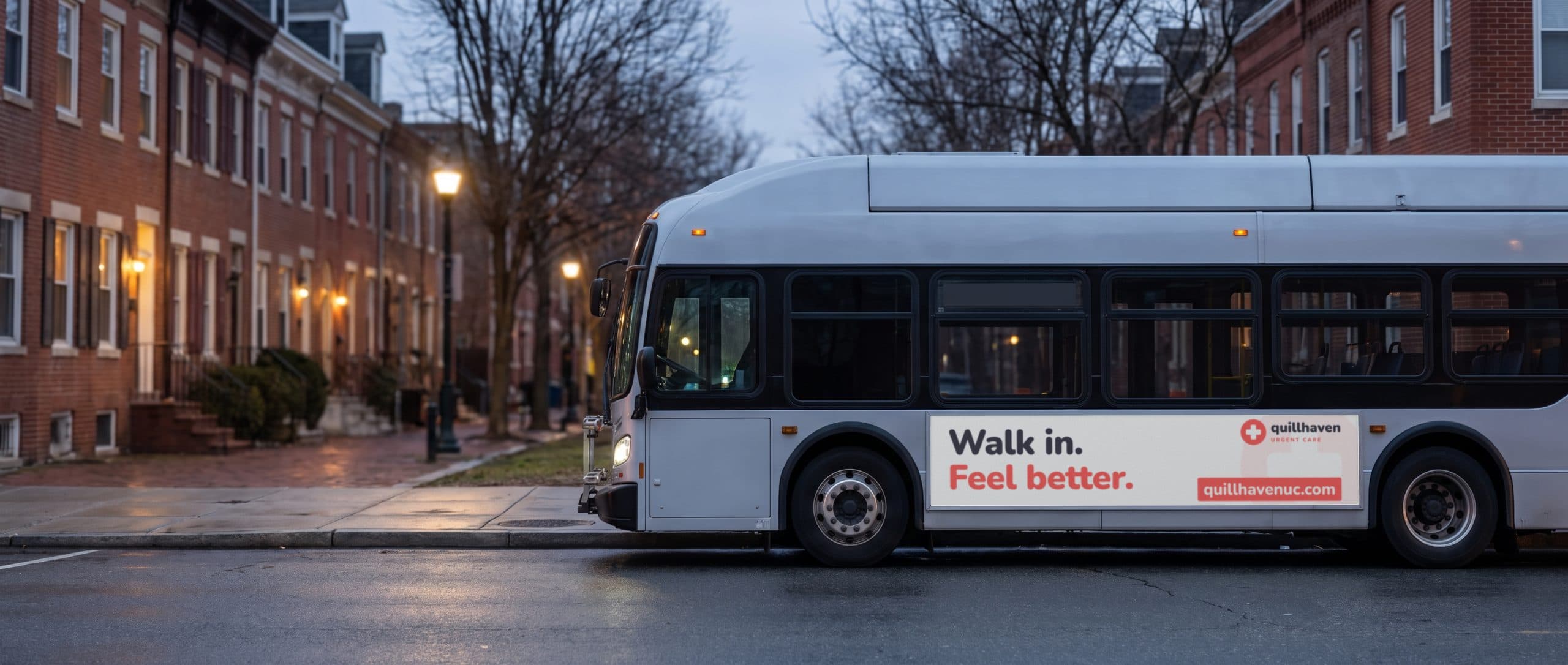
How does advertising on buses work?
A transit agency owns the buses. It decides whether to sell ad space on them at all, and if it does, it either sells the space with its own staff or hires a media company to sell it. Either way, you are renting space on a public vehicle for a set term, and the agency keeps the final say on what goes up.
Not every agency sells ads. The Riverside Transit Agency in Southern California says plainly that it does not allow advertising on the interior or exterior of its buses. So the first question in any city is whether the buses carry ads at all.
Here is a plain example of transit advertising. A roofing company wants its name in front of people across one county. It buys king panels on 10 buses for six months. It sends the art to the agency, the agency approves it, a printer makes the vinyl, and an installer puts it on. For six months, the panels ride wherever those buses are sent each day.
That last part matters. Most agencies do not promise routes. Richmond's transit company says it is not able to commit your ad to any specific bus route, because its buses rotate daily. Gold Coast Transit in Oxnard says it is unable to limit ads to specific routes or areas. You are buying a city's fleet, more or less, not a single street.
The rest of this guide covers who to call, what the formats are called, how to read the rate card, what a wrap really costs, and how to buy, step by step.
Who sells bus advertising?
There are two models. In smaller systems the agency usually sells its own space. In bigger ones it often signs a contract with a media company, and that company sells the space and handles the installs.
The agency sells it directly
Plenty of agencies post their rates and a staff contact. Green Bay Metro lists a king at $140 a month and a full wrap at $900, and gives a 13th month free on a 12-month buy. Billings, Montana's MET Transit takes ads by email and phone and lists taillight signs from $200 a month and full side wraps from $600 a month, or $1,200 to $1,400 for both sides. The Champaign-Urbana Mass Transit District has an advertising specialist and lists kings at $300 a month. You deal with a public employee, and the rate card is often online.
A media company sells it under contract
In many metros, you call a media company instead. An undated Denver transit rate card hosted on Lamar's site lists $545 for a king and $455 for a queen under "4 week space rates", says rates are net, and tells buyers to contact a Lamar rep. The company sells the space and coordinates installs. The agency still owns the buses and its policy still decides what runs.
Buses in Los Angeles, San Diego and Sacramento
Los Angeles. LA Metro's advertising page sends bus advertisers to OUTFRONT Media for bus interiors and exteriors and to Intersection for rail stations and trains. The formats it lists include full wraps, Ultra Super Kings, kings, queens, tails and car cards.
San Diego. San Diego MTS lists Clear Channel Outdoor for bus and trolley wraps and for bus shelters, and BriceHouse Outdoor for bus benches.
Sacramento. SacRT sends advertisers to Lamar Advertising for buses, light rail trains and stations, and to Clear Channel Outdoor for bus shelters and stop benches.
Bus ad formats: king, queen, tail, kong and wrap
Bus ads have trade names, and every rate card uses them. Learn these five and you can read any card. The definitions below follow Geopath's transit glossary, the industry's audit body. Sizes are from the cards named, and they vary by agency and bus length.
| Format | Where on the bus | Also called |
|---|---|---|
| King | A long panel on the side of the bus; either side per Geopath. Richmond and Oxnard list it at 144 by 30 inches; Oxnard sells it on the street side. | Bus side, king-size poster |
| Queen | A shorter side panel, usually on the curb side. Listed at 88 by 30 inches in Oxnard and Richmond. | Curbside, queen-size poster |
| Tail | A panel at the rear, usually under the windows. Oxnard lists 16 by 72 inches; Richmond lists 58 by 21. | Taillight display, bus back, back of bus ad |
| Kong / Super King | An oversize side panel, usually on the street side. Richmond's King Kong runs fender to fender with window perf. Oxnard's Ultra Super King is 98 by 241 inches. | Super King, Ultra Super King, King Kong |
| Wrap | Vinyl over a whole side (half wrap) or the whole bus. Geopath's fully wrapped bus covers the vehicle, windows included, with see-through vinyl. Richmond's full wrap covers all sides except the roof. | Full wrap, half wrap, side wrap |
| Interior card | A card in a frame above the passenger seats, seen by riders, not the street. | Car card, channel card |
Names from the Geopath transit glossary. Sizes from the Richmond (GRTC, updated October 2024) and Gold Coast Transit (2022) rate cards. Check your agency's card for its sizes.
A few more you will see. A headlight display sits on the front of the bus, under the windshield. A full back covers the whole rear. On a search for bus sides, you will find kings, queens and kongs. On bus backs, tails and full backs. Most agencies also sell space on shelters and benches, often through a different company. See bus shelter ads and our bus bench advertising guide.
Which format to pick? The king is the workhorse because it faces traffic and costs far less than a wrap. A tail is seen by the drivers stuck behind the bus. A wrap is the loudest and the most expensive, mostly because of the printing.
How to read a transit rate card
A rate card is the agency's price list. Search for your city plus "metro bus advertising rates" and you will often find one as a PDF. They all show the same handful of things. Read each one before you compare two cards.
- The unit. Most cards price one ad on one bus. Gold Coast Transit says it plainly: monthly, per ad, per bus.
- The period. A calendar month on most agency cards. Four weeks on the Denver card. Thirteen four-week periods make a year, so the two are not the same.
- The term discount. Longer runs cost less per month. A king at Gold Coast Transit falls from $520 on the open rate to $330 on 12 months.
- The minimum. Richmond has a $1,000 minimum buy. LeeTran in Lee County, Florida, requires a six-month contract for bus ads.
- Production and install. Usually separate. Richmond lists production per bus next to every format. Gold Coast includes one install and removal but not design or printing.
- Design. Many agencies do not design ads. Champaign-Urbana's MTD does not provide graphic design services, and Gold Coast does not design or print.
- Discounts. Some cards list agency and nonprofit discounts. Gold Coast lists 15% for advertising agencies.
| Agency | King, shortest term | King, longest term | Production |
|---|---|---|---|
| Richmond, VA (GRTC, Oct 2024) | $355 per month (1 month) | $300 per month (12 months) | $155 per bus (card) |
| Oxnard-Ventura, CA (Gold Coast Transit, 2022) | $520 per month (open rate) | $330 per month (12 months) | Design and printing not included (card) |
| Champaign-Urbana, IL (MTD) | $300 per month | Not listed | $230 per sign for production, install and removal (page) |
Prices as published by each agency; dates on each card. Cards change, so ask for the current one.
For price ranges by format, see bus advertising cost. For how bus ads compare with billboards and other outdoor formats, see outdoor advertising cost.
How much does a bus wrap cost?
A bus wrap has two prices, and most pages blur them together. The first is the space: what the agency charges to keep your wrap on the bus each month. The second is production: printing the vinyl and installing it on that bus. On a wrap, production is the big number.
Richmond's card shows the split cleanly. A full wrap covers every side except the roof. The space runs $3,000 a month for one month, down to $2,350 a month on a 12-month term. Production is $8,000 per bus. A half wrap, one complete side, runs $1,500 a month down to $1,300, plus $4,000 per bus to produce.
So a one-month full wrap in Richmond costs $11,000 for the first month. Spread over a year, the production adds about $667 a month on top of the $2,350 space rate. That is why short wrap runs rarely make sense. You pay the full print cost whether the wrap stays up for one month or twelve.
Space prices vary a lot by market. Green Bay lists a full wrap at $900 a month and a half wrap at $500. Blue Line Media, an ad agency, publishes $3,500 to $12,500 per four weeks for full wraps across its markets. Agency cards are the firmer number where they exist.
Ask three things before you sign. Who prints the vinyl, and does the agency require a specific material? Gold Coast Transit, for example, accepts only one named removable vinyl for exterior ads. Is removal included when the run ends, or billed? And how long does install take? Gold Coast says installs are scheduled around bus service and may take several days.
How to buy a bus ad, step by step
- Find the seller. Go to your transit agency's website and look for an advertising page. It names a staff contact or the media company that sells its space.
- Ask about areas, not routes. Ask which parts of town the buses serve. Many agencies rotate buses daily and will not promise a route.
- Get the rate card and the ad policy. Read the unit, period, minimum, production and install lines. Read the policy before you design anything.
- Size the buy. Pick the format, the number of buses and the number of months. Longer terms lower the monthly rate.
- Send art to spec. Use the agency's exact size and material. If the agency does not design ads, hire a designer who has done transit work before.
- Get approval. The agency checks the art against its policy before anything is printed.
- Print and install. The printer ships the vinyl, and the installer puts it on around bus service.
- Ask for proof. Get a photo of your ad on each bus. Add a tracking number so you can count your own calls.
Why the policy step? A transit agency is a government body, so its ad rules have to hold up under the First Amendment. In a 2018 case about Washington, D.C.'s Metro, the federal appeals court treated the agency's ad space as a nonpublic forum. In that kind of space, rules must be reasonable and viewpoint neutral. In practice, agencies write their rules down and apply them to every ad, and some topics are off the table for everyone.
Media buyers can skip a few steps by going through a broker. Dash Two, a broker, says it secures the routes, manages production and coordinates with each transit authority. You still go through the agency's approval. If you buy for clients, see our agencies page.
Where garbage trucks fit next to bus ads
A city garbage truck ad is the same kind of deal as a bus ad. It is a public vehicle. There is a contract for the ad space, a written ad policy, and a printed panel. The difference is the streets. Buses follow main roads and transit corridors. Collection trucks run residential routes on the city's schedule.
So a garbage truck panel works as an addition for the neighborhoods your bus buy does not reach. It is not a replacement. Cities have put ads on their refuse trucks. Columbus, Georgia's council approved a contract for it in 2021. Read more in can you advertise on garbage trucks?.
Ours is a framed sign, not a wrap. The printed panel slides out of the frame. The panel live area is 91 x 27 in, with two sides per truck. See the panel size and specs. The printed panel swaps in under 30 seconds. A new message still goes through design, review and printing first.
Like bus routes, truck routes are set by the city. Pick your city. See which areas its routes cover. In each city, every ad will be checked against that city's written ad policy before it runs. Refuse trucks are not part of the industry's audited audience ratings, so any reach figure we show is labeled as an estimate, with how we got it. Add a tracking number to your panel and count your own calls.
No city is open yet. Read how garbage truck advertising works, see your ad on a truck, or join the list for your city and we will write when it opens.
Sources
- GRTC (Richmond, VA): Advertising rates, updated October 2024 (PDF)
- Gold Coast Transit District: Advertising rate card, January 2022 (PDF)
- LeeTran (Lee County, FL): Transit advertising rate card, 2022 (PDF)
- Lamar (seller): Denver, CO transit rate card, undated (PDF)
- City of Green Bay: Metro Transit advertising rates
- City of Billings: Advertise with MET Transit
- Champaign-Urbana MTD: Advertise
- Riverside Transit Agency: Bus and bus shelter advertising
- LA Metro: Advertising
- San Diego MTS: Advertising
- SacRT: Advertising
- Geopath: Transit glossary
- Geopath: Transit FAQs
- Blue Line Media (agency publication): Bus exterior advertising
- Dash Two (agency publication): Bus advertising
- American Freedom Defense Initiative v. WMATA, D.C. Cir. 2018 (Justia)
- Columbus, Georgia city council minutes, April 13, 2021 (Resolution 111-21) (PDF)
Written by
Roadway Displays
Roadway Ad Network is a business line of Roadway Displays, which has built sign frames for refuse and recycling trucks since 1987. We make the frames and print the panels ourselves.
Published · Updated · About us