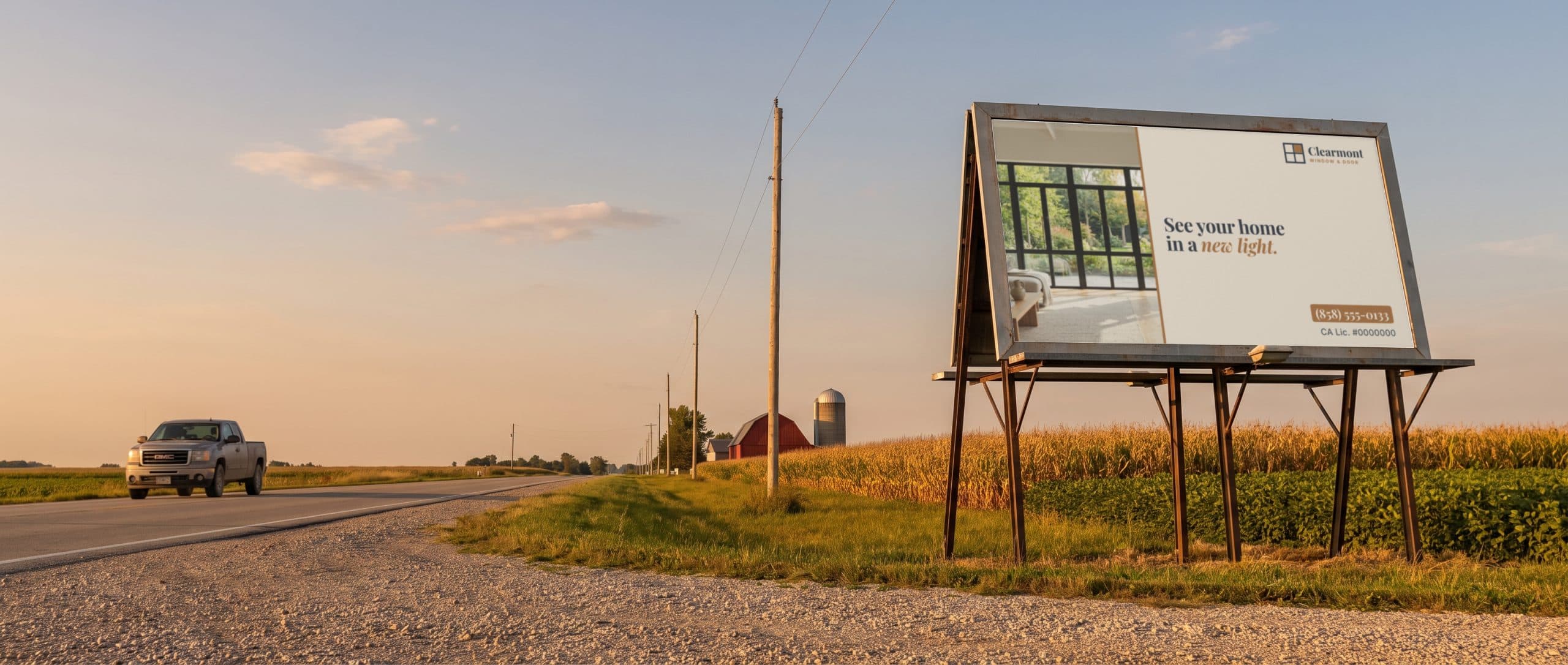
What is the cheapest way to advertise on a billboard?
The cheapest real billboard is usually a poster board on a secondary road, or a self-serve digital slot bought by the day. Both get your name on a board for far less than a big bulletin on a freeway.
How cheap? Blindspot's 2026 cost guide says small rural boards start around $200 a month, and puts the national average at roughly $3,953 per four-week cycle. Blue Line Media, an agency, lists junior posters at $300 to $750 per four weeks and standard posters at $750 to $4,000. On the digital side, Blip sells plays from $0.01 each with no minimum spend.
Below billboards sit benches, shelters and transit ads. They are not billboards, but they put your name outdoors for less a month. If you are looking for cheap billboards near you, the same eight options apply. Price depends heavily on the market.
Here are the eight options, ranked roughly from the closest thing to a real billboard down to street-level formats. Every price comes from a public page, linked in the table and in the sources at the end.
| Option | Published price | Minimum | Source |
|---|---|---|---|
| 1. Poster board, secondary road | Posters $750 to $4,000; junior posters $300 to $750, per four weeks | Four-week periods; $5,000 or more per market | Blue Line Media |
| 2. Self-serve digital slot | From $0.01 per 8-second play | No minimum spend, no contract | Blip |
| 3. Rural or small-market bulletin | Small rural boards from about $200 a month | Four-week cycles | Blindspot |
| 4. Bus bench | $150 to $450 per bench per four weeks (seller estimate) | Varies; Blue Line lists $5,000 or more per market | AdQuick |
| 5. Bus shelter | $300 to $1,500 per panel per four weeks in smaller markets (seller estimate); $440 to $495 a month on one transit card | $1,000 minimum on the Richmond card | AdQuick; GRTC |
| 6. Interior bus cards and bus tails | Interior cards $275 to $425 a month for the full fleet; tails $245 to $375 a month per bus | Monthly, lower rates on longer terms | Gold Coast Transit |
| 7. Mobile billboard truck for a day | $175 an hour with an 8-hour minimum; $500 to $900 a day for a static truck (sellers) | One day | Billboard Express; The Rolling Ads |
| 8. Panel on a city garbage truck | Talk to us for pricing | No city is open yet | How it works |
Prices as published by each source; check the date on each page.
1. Poster boards on secondary roads
A poster is the smaller billboard you see on city streets and secondary roads, usually 12 by 24 feet. A bulletin, the big freeway board, is 14 by 48. AdQuick lists static posters at $750 to $2,000 per four weeks, against $1,500 to $30,000 for static bulletins. Blue Line Media lists posters at $750 to $4,000 and junior posters, smaller still, at $300 to $750.
Posters are sold the way bulletins are: in four-week posting periods, with the art printed and installed for you, usually at extra cost.
The catch: location. Posters sit on slower, smaller roads, so fewer people pass each one. A poster on a road your customers use every day can beat a bulletin on a highway they never take. Drive past it before you sign.
2. Self-serve digital billboard slots
Self-serve platforms let you buy time on digital billboards without a four-week lease. Blip is one example. Its pricing page says plays start at $0.01 per 8-second display, with no minimum spend and no long-term contract. You choose the boards, set a daily budget and can start and stop when you want. Blindspot sells on a similar pay-per-play model and says plays start as low as $0.15.
This is the most common way to get on a billboard for a day or a few days. If you want a board for a grand opening or a weekend event, digital is where to look. Static boards rarely rent by the day.
The catch: you share the screen. A digital board rotates several advertisers in a loop, and you only get the plays you pay for. A few dollars a day buys a few plays, not the board. Price per play also changes with location, time of day and demand, so the cheap number on the pricing page is a starting point. Art needs to read in 8 seconds or less.
3. Rural and small-market bulletins
The same big board costs far less outside a big city. AdQuick's 2026 market table shows a static bulletin at $5,000 to $50,000 or more per four weeks in New York, and $1,000 to $8,000 in Phoenix. Blindspot says small rural boards start around $200 a month.
If your customers are in a smaller town, or along a rural highway into town, you can often get a full-size board for the price of a small poster in a big city.
The catch: fewer people pass each board. That is fine if they are the right people. A board on the road into a small town your customers drive every day can be a good buy. A board in a small market far from your service area is cheap for a reason.
4. Bus bench ads
A bench ad sits on a bus stop bench, at curb level, where drivers stop at lights and people wait for the bus. It is one of the cheapest outdoor formats on a per-month basis.
AdQuick, which sells outdoor media, estimates a single bench at $150 to $450 per four-week cycle nationally: $300 to $450 in the 10 biggest markets and $100 to $250 in small markets. Blue Line Media lists benches at $400 to $750 per four weeks, with a minimum purchase of $5,000 or more per market that can be spread across displays and periods.
The catch: sellers often set a minimum buy, so one bench on its own may not be an option. Benches also sit at curb level, so they suit people close by more than fast traffic. More on prices and how to buy in our guide to bus bench advertising.
5. Bus shelter ads
A shelter ad is a lit or unlit poster on the side panel of a bus stop shelter. It is bigger than a bench and seen by drivers, people walking and riders waiting.
AdQuick's market table puts a shelter panel at $300 to $1,500 per four weeks in markets outside the top 30, $750 to $3,000 in markets 11 to 30, and $1,500 to $10,000 or more in the top 10. Transit agencies publish their own cards. In Richmond, Virginia, GRTC lists shelter windscreens at $495 a month for one month down to $440 a month on a 12-month term, plus $300 production and a $1,000 minimum purchase.
The catch: shelter programs are run city by city, often by a contractor, and some agencies do not sell them at all. Riverside Transit Agency, for one, says it does not allow ads on its shelters. More in our page on bus shelter advertising.
6. Inside-the-bus cards and small-agency bus ads
Small transit agencies publish some of the lowest outdoor prices around. Gold Coast Transit District, which serves Oxnard, Ventura, Port Hueneme and Ojai in California, lists interior cards at $275 to $425 a month for one ad per bus across the whole fleet, on its 2022 card. Its tail ads, on the back of a bus, run $375 a month on the open rate down to $245 on a 12-month term. In Richmond, GRTC lists a rear ad at $230 down to $175 a month, plus $85 a bus for production.
Exterior side panels cost more but are still modest on small-agency cards. A king panel on the side of a bus is $520 down to $330 a month on Gold Coast's card, and $355 down to $300 on GRTC's.
The catch: you do not pick the route. Both GRTC and Gold Coast say they cannot hold your ad to specific routes. Design and printing are usually yours to pay for. See our guide to advertising on buses.
7. A mobile billboard truck for a day
A mobile billboard is a truck with a sign on each side that drives a route you choose. It is one of the easier ways to be outdoors for a single day, such as an event or an opening.
Sellers publish their own day rates. Billboard Express lists $175 an hour with an 8-hour minimum. The Rolling Ads lists $500 to $900 a day for a static truck and $800 to $1,500 for an LED truck, both for 8 hours. LED Truck Media's 2026 guide puts static trucks at $800 to $1,500 a day.
The catch: cheap for a day, expensive for a month. The Rolling Ads lists an LED truck at $14,000 to $28,000 for a monthly campaign, and Billboard Express lists $24,000 a month. Read more in our guide to billboard truck rental.
8. A panel on a city garbage truck
This is the format we sell, so here it is plainly. Garbage truck advertising is a framed panel on a city collection truck. It is a framed sign, not a wrap. The panel's live area is 91 by 27 inches, on two sides of the truck. The printed panel swaps in under 30 seconds. A new message still goes through design, review and printing first.
Where it fits: a month-after-month presence on the routes a city's trucks work, at street level. It is not a one-day burst for an event. For that, look at options 2 and 7.
We are opening it city by city, and no city is open yet. Prices are set city by city, so there is no number to publish here. Talk to us for pricing. In the meantime, you can see your ad on a truck, or read how garbage truck advertising works.
Cheapest per month vs cheapest per thousand
A low monthly price is not the same as a low price per view. The industry measures that with CPM, the cost per thousand impressions: what you pay for every 1,000 estimated chances to see the ad.
Solomon Partners' 2025 media CPM comparison, hosted on the OAAA's site, gives these ranges for outdoor formats, based on contracts executed through DOmedia:
| Format | CPM range (2025) | Source |
|---|---|---|
| Bulletins | $3 to $10 | Solomon Partners |
| Posters | $3 to $9; up to $13 for non-static | Solomon Partners |
| Transit shelters | $2 to $7; up to $8 for non-static | Solomon Partners |
Solomon estimates as of June 2025, read from the published chart.
Look at what that means. A bulletin costs far more per month than a poster, but the two overlap per thousand. The cheap face is not always the cheap reach. Ask every seller for both numbers, the monthly price and the CPM, and where the impression count came from.
Garbage trucks have no CPM. Refuse trucks are not part of the industry's audited audience ratings: Geopath's transit list covers buses, rail, ferries and stations. So any reach figure we show is labeled as an estimate, with how we got it.
How to keep billboard costs down
Whichever option you pick, these habits keep the bill lower.
- Run longer for a lower monthly rate. Many rate cards drop the price on longer terms. GRTC's king panel goes from $355 a month on one month to $300 on twelve; Gold Coast's goes from $520 to $330.
- Reuse one design. Printing and installation are often billed per run. Gold Coast's card says rates do not include design or printing. One good design you keep up costs less than a new one each month.
- Ask about open faces. Ask the seller what is unsold in the weeks you want and what they will take for it. Blindspot notes that longer commitments and less competitive weeks and placements can leave room to negotiate.
- Be flexible on timing. If your dates can move, ask what the slower weeks cost.
- Keep the art simple. Name, service and one way to reach you. Simple art is easier to read and easier to reuse.
- Count the calls. Put a tracking number on every format. The cheapest option is the one that brings customers for the least money, not the one with the smallest invoice.
For prices across every format in one place, see our guide to outdoor advertising cost.
Sources
- Blindspot (seller): How much does a billboard cost (updated July 2026)
- Blue Line Media: Billboard advertising (agency publication)
- Blue Line Media (agency publication): Bench advertising
- Blip (seller): Digital billboard pricing
- AdQuick (seller): Billboard advertising (format and market tables)
- AdQuick (seller): Bus bench advertising
- AdQuick (seller): Bus shelter advertising
- Greater Richmond Transit Company (GRTC): Advertising rates
- Gold Coast Transit District (GCTD): Rate card, 2022
- Riverside Transit Agency: Bus and bus shelter advertising
- Billboard Express (seller): Cost and rates
- The Rolling Ads (seller): Mobile billboard pricing guide 2026
- LED Truck Media (seller): Mobile billboard advertising cost 2026
- Solomon Partners: 2025 US core media CPM comparison (hosted by OAAA)
- Geopath: Transit FAQs (media types Geopath audits)
Written by
Roadway Displays
Roadway Ad Network is a business line of Roadway Displays, which has built sign frames for refuse and recycling trucks since 1987. We make the frames and print the panels ourselves.
Published · Updated · About us