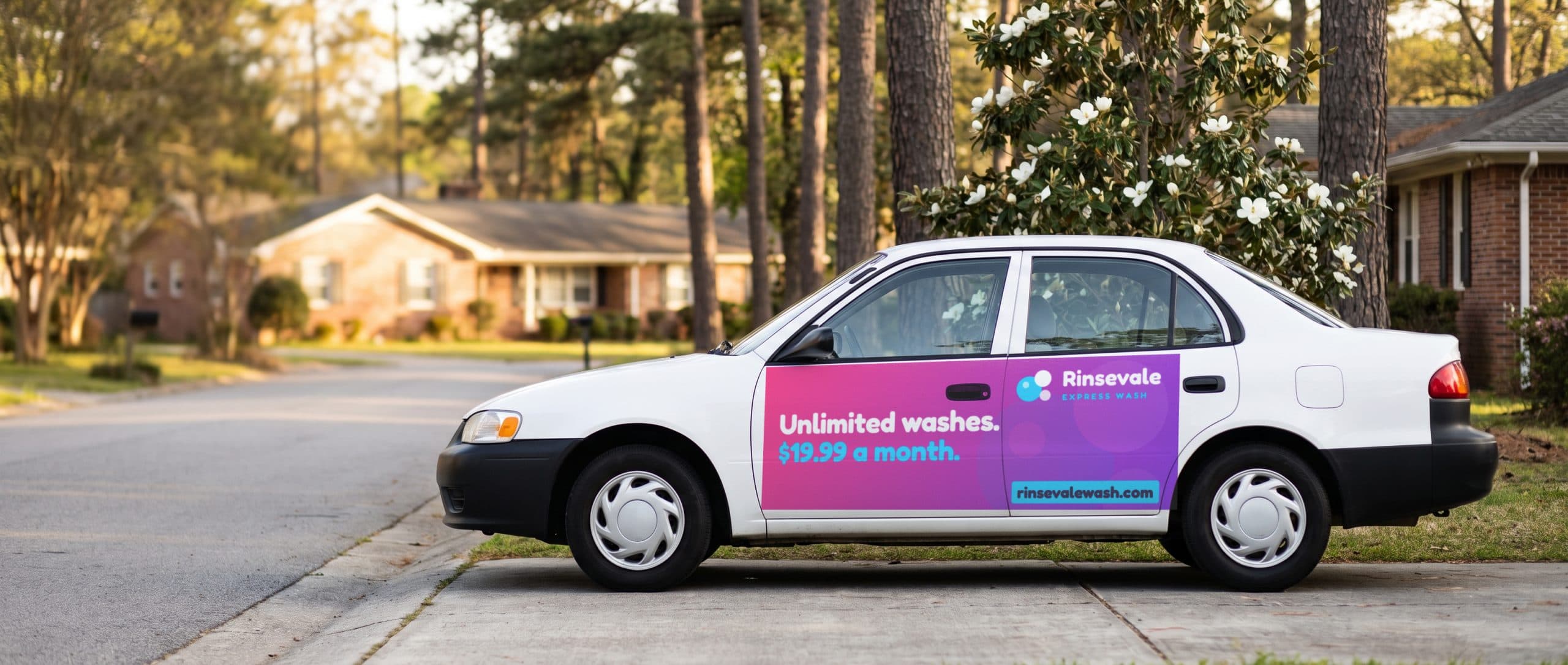
How does car advertising work?
"Car advertising" means two things online. Some people want ads for cars, the kind a dealership runs. This guide is about the other kind: ads on cars, where a car carries a business's message around town.
There are four ways to do that, and they work very differently. In two of them you rent space on cars someone else drives. In one you turn your own cars into signs. The fourth is a step up in size: a panel on a city garbage truck. Who drives, what you pay for and how much you control changes with each.
Where we quote a price, it comes from the seller's or shop's own page, labeled "(seller)" and linked in the sources at the bottom. We didn't test any of these programs, and prices change by market and date.
| Way | Who drives | What you buy | What you control | Read more |
|---|---|---|---|---|
| 1. Wrap network | Everyday drivers, often rideshare and delivery | Space on a set number of cars, by the month | The market, the car count, the term | Vehicle wrap advertising |
| 2. Rooftop toppers | Taxi and rideshare drivers | A sign on the roof, per car, per four weeks | The market; digital tops can target areas and hours | Taxi and rideshare advertising |
| 3. Your own cars | You and your staff | Design, print and install, once | Everything, but only where you already drive | Ads on trucks |
| 4. City garbage truck panel | The city's crew or its hauler's | Talk to us for pricing | The city; trucks rotate, no route guarantee | Garbage truck advertising |
How each way works in general. Terms vary by seller, market and city.
Rideshare car wrap programs (Carvertise, Wrapify)
This is what most people picture when they hear "ads on cars." A network signs up everyday drivers, wraps their cars with an advertiser's design, and pays the drivers a monthly fee. The advertiser pays the network. Carvertise (seller), founded in 2012 in Wilmington, Delaware, describes its product as fleets of branded rideshare vehicles. Wrapify (seller) works the same basic way, with drivers who sign up through its app.
Because the cars belong to the drivers, you don't pick the streets. The cars go wherever their owners drive: rideshare trips, deliveries, commutes. What you choose is the market, how many cars, how much of each car is wrapped, and for how long.
What it costs (seller pages)
- Wrapify (seller). Its regional page lists $6,000 a month for 10 cars on a 12-week term, $5,000 a month on 24 weeks and $4,000 a month on 52 weeks, each with rear-window (180) coverage.
- AdQuick (seller). Its car wrap page lists an average of $1,500 to $3,500 per vehicle for a full wrap, $800 to $1,800 for a partial wrap and $150 to $400 for a rear window only.
- Term. Carvertise tells drivers campaigns usually run three to twelve months. AdQuick says most campaigns are structured in 3-month or 6-month flights.
Those numbers aren't apples to apples. One is a monthly price for a group of cars, the other is an average per vehicle. Before you compare, ask each network the same questions:
- How many cars, in which market, for how many weeks?
- How much of each car is wrapped: rear window, partial or full?
- Is design, printing, install and removal in the price?
- What report do I get: dates, miles, which areas the cars drove?
- What happens if a driver drops out mid-campaign?
Networks also publish audience estimates. Treat them as the seller's own estimates and ask how they were counted. Geopath's list of audited transit media covers bus and station formats; we found no audited rating for car wraps. The simplest proof is your own: put a phone number or short web address on the wrap that appears nowhere else, and count what comes in. For the full cost table, see vehicle wrap advertising.
Rooftop toppers and digital car tops
The second way puts the ad on the roof. Taxis carry roof signs, and many are now digital screens on taxis and rideshare cars, and some sellers call them car tops or toppers. The sign is small next to a wrap, but a digital top can change its message by area and time of day.
Firefly (seller) runs GPS-enabled digital tops on taxis and rideshare vehicles. Its site lists New York, Chicago, Los Angeles, San Francisco, Dallas, Las Vegas, Austin, Miami, Boston, Philadelphia, Atlanta, Phoenix, Washington DC, Houston and Toronto for its digital top network, and says campaigns can be set by geofence, ZIP code, DMA and time of day. It also sells static tops and wraps.
What car tops cost (seller pages)
- Blue Line Media (seller) lists a digital rideshare (Uber/Lyft) top at $450 to $750 and a rideshare full wrap at $800 to $1,500, with a minimum purchase of $5,000 per market or higher.
- AdQuick (seller) lists static taxi tops at $100 to $500 per vehicle per four weeks, digital taxi tops at $120 to $800, and rideshare tops at $150 to $700 with a $5,000 minimum per market.
The minimum matters more than the per-car price for a small business. A $5,000 floor per market means a car top campaign is a real budget line, not a test you run for a few hundred dollars.
One thing that confuses searchers: "Uber advertising" and "Lyft advertising" often lead to the ride companies' own ad businesses. Lyft Ads, for example, lists in-app ads and sponsored map ads alongside car wrap branding. Toppers and wraps on rideshare cars are also sold by third-party networks like the ones above. For every published topper rate, see taxi and rideshare advertising.
Putting ads on your own cars
If your business already runs cars, the cheapest ad on a car is the one on your own. Sales reps, home-visit services, real estate agents and delivery drivers all drive the same towns their customers live in. A wrap or simple lettering turns that driving into a sign, and there's no monthly fee for the space.
- Full wrap on a sedan. $2,500 to $4,500 at Hyperformance Graphics, a North Carolina wrap shop. Chicago Fleet Wraps lists a full sedan wrap at $2,950 installed, above its $2,850 minimum.
- Partial wraps and decals. Hyperformance puts them at about $800 to $2,500.
- How long it lasts. Hyperformance says cast vinyl generally lasts five to seven years and economy calendered vinyl three to five.
The catch is reach. Your wrap only goes where you go. If your team covers a few nearby towns, that's exactly right. If you want to be seen in places your cars never drive, you need one of the other ways. If you run vans or trucks too, our guide to ads on trucks covers wraps by vehicle size, and vehicle wrap advertising has more shop prices.
Is it legal to put ads on cars?
In general, yes: a wrap or decal on the body of a privately owned car is ordinary advertising. The rules people run into are about windows and about local limits on cars for hire.
- Windows in California. Vehicle Code 26708 bars signs and other material on the windshield and side or rear windows, with exceptions. Two matter for ads: side windows behind the driver are exempt, and so is the rear window if the car has outside mirrors on both sides that show at least 200 feet behind it. Small stickers are allowed in set corners of the windshield and rear window.
- Cars for hire. Cities can regulate ads in taxis and rideshare cars. In 2019 a federal appeals court said New York City can ban ads inside Uber and Lyft cars, upholding the city's rule.
Not legal advice
This is a summary of public sources, not legal advice. Read section 26708 yourself, and check your own state and city rules, or the network's terms, before you put anything on a window.
Can you get paid to put ads on your car?
Most people who search "ads on cars" are asking this, so here is a short, plain answer. Yes, programs pay drivers to carry wraps. The pay is real but modest, and it depends on where you live and how much you drive.
- Carvertise (seller) says base campaign pay is $100 a month and most drivers make $450 to $1,500 a month. It asks for a 2015 or newer car without significant dents, says campaigns usually run three to twelve months, and says install and removal are free.
- Wrapify (seller) shows per-month estimates from $174 to $452, depending on how much of the car is wrapped, with no upfront costs.
Watch for scams. The FTC has warned about fake car wrap offers that promise as much as $700 a week, send a check, and ask you to pass part of the money to a "decal agent." The check is fake, so the money you sent comes out of your own pocket. Never send money to get wrapped.
We don't run a driver program and don't recommend any. Read the terms before you sign, and check the window rules above.
Where garbage truck panels fit
A car is a small canvas that goes wherever its driver goes. A city garbage truck is a much bigger vehicle doing a fixed job: it works residential streets on the city's collection schedule. That makes it a different kind of ad, closer to a sign that travels through neighborhoods than a car that wanders a metro.
Cities have put ads on their refuse trucks. Columbus, Georgia's council approved a contract for it in 2021. A refuse truck belongs to the city, so the city has to approve ads before anyone can sell the space. Read more in can you advertise on garbage trucks.
This is the format we build. Roadway has built sign frames for refuse and recycling trucks since 1987. Here is how it works:
- A framed sign, not a wrap. The printed panel slides out of the frame.
- Two sides per truck. The panel's live area is 91 x 27 in. Sizes and file rules are on the specs page.
- Fast swaps. The printed panel swaps in under 30 seconds. A new message still goes through design, review and printing first.
- Checked first. In each city, every ad will be checked against that city's written ad policy before it runs.
- Trucks rotate. Trucks rotate through the city's collection routes. You don't choose the route, and there is no route guarantee.
No city is open yet. Refuse trucks are not part of the industry's audited audience ratings (Geopath), so any reach figure we show will be labeled as an estimate, with how we got it. Add a tracking number to your panel and count your own calls, the same way you would on a car. See how it works, or see your ad on a garbage truck.
Which way fits your business?
Start from your situation, not the format.
- You already drive for work. Wrap or letter your own cars first. You pay once, and the ad works every day you're on the road.
- You want a whole metro for a season. A wrap network can put your design on a set number of cars for a few months. Get the car count, term and report in writing.
- You want to change the message by area or hour. Digital car tops do that, in the markets where they run. Plan around the per-market minimum.
- You want one big push for a weekend. Cars aren't the tool. Rent a billboard truck and plan the route yourself.
- You want residential neighborhoods and a bigger sign than a car. A panel on a city garbage truck. No city is open yet; join the list for yours.
Many businesses use more than one. Lettering on your own cars plus a rented truck for an opening is a common pair. To compare every format side by side, read outdoor advertising cost and truck advertising cost.
Sources
- Carvertise (seller): Rideshare advertising and branded vehicle campaigns
- Carvertise (seller): For drivers
- Wrapify (seller): Regional always-on pricing
- Wrapify (seller): Get paid to advertise on your car
- AdQuick (seller): Car wrap advertising, updated October 2026
- AdQuick (seller): Taxi advertising pricing
- Firefly (seller): Digital tops, static tops and car wraps
- Blue Line Media (seller): Taxi and rideshare advertising rates
- Hyperformance Graphics (wrap shop): Vehicle wrap cost 2026
- Chicago Fleet Wraps (wrap shop): Vehicle wrap cost, May 2026
- California Legislative Information: Vehicle Code section 26708
- Associated Press via The Washington Times: Appeals court: NYC can ban ads in Uber and Lyft cars (July 16, 2019)
- Federal Trade Commission: Consumer alert on car wrap scams
- Lyft Ads (seller): Ad formats
- Geopath: transit media audited by Geopath (FAQ)
- Columbus, Georgia city council minutes, April 13, 2021 (Resolution 111-21)
Written by
Roadway Displays
Roadway Ad Network is a business line of Roadway Displays, which has built sign frames for refuse and recycling trucks since 1987. We make the frames and print the panels ourselves.
Published · Updated · About us