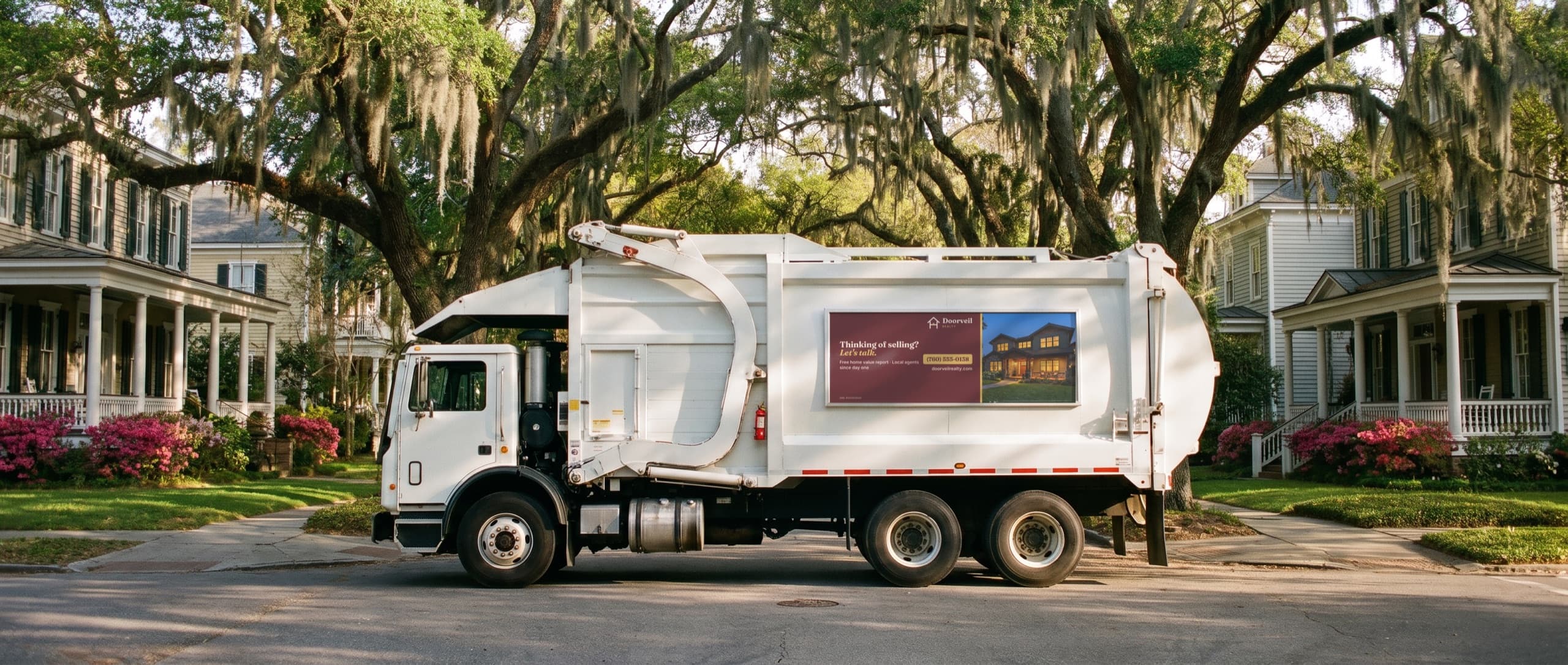
What garbage truck advertising is
It is a sign on the side of a refuse truck. A business pays for the space. The city owns the truck, and the city sets the rules for what can go on it.
There are two common ways to do it. A wrap is printed vinyl stuck to the truck body. A framed panel is a printed sign that sits in a frame on the truck. We build the second kind. A framed sign, not a wrap. The printed panel slides out of the frame.
The frame and the panel
- The frame. It is aluminum, and it holds the panel with spring tension. We make the frames ourselves.
- The panel. It is a printed sign that fits inside the frame. The live area, where your art shows, is 91 inches wide by 27 inches tall. A truck has two sides, so a truck has two panels.
- The swap. The printed panel swaps in under 30 seconds. A new message still goes through design, review and printing first.
- The print. We print the panels ourselves.
Why does the swap matter? Because a message that fits March does not fit July. A roofer wants a different line in rainy season than in a dry one. A dentist wants one line at back-to-school time and another at the end of the year. A frame lets the message change without rebuilding the whole sign.
There is also a plain feature that no screen can copy. Nothing to skip. Nothing to block. The truck is just there, on its route, with your name on it.
A short history of ads on garbage trucks
Our part of the story is the frame. We have built sign frames for refuse and recycling trucks since 1987. Cities bought those frames to put their own messages on their own trucks. The advertising program on this site is new, and it is separate from that frame business.
The rest of the history belongs to the cities. Here is what they did, in their own public records and in the news. None of it is a Roadway result.
Columbus, Georgia, 2021
Columbus ran a request for proposals first. Then, on April 13, 2021, its city council adopted Resolution 111-21. The resolution approved a contract with a marketing company to find clients to place body wrap ads on city-owned refuse trucks. You can read the council minutes and the agenda item for the request for proposals for yourself.
This is the clearest record we have found. A city council voted in public, the city picked a seller through a bid, and the contract is on file.
Other cities
- Hollywood, Florida. City commissioners voted 4 to 3 to allow ads on garbage trucks and said some kinds of business would not be welcome. Source: Sun-Sentinel.
- Moline, Illinois. A 2015 local news story reported new Mediacom ads on the city's garbage trucks. Source: Dispatch-Argus.
- Philadelphia. In 2013 the city council voted 15 to 0 to allow ads on city property, and trash trucks were reported to be first in line. Source: The Inquirer.
- Santa Monica, California. Waste Dive has reported ads on the city's recycling trucks. Source: Waste Dive.
- Valparaiso, Indiana. Waste Dive reported that the city considered buying refuse trucks fitted to hold ads. Source: Waste Dive.
What does this history show? That cities can say yes, and that they say it in public with a written process. What it does not show is what any program earned or how it ended. We do not know that for most of them, so we do not claim it.
Want the short version of this section? Read our guide, can you advertise on garbage trucks.
How cities approve ads on their trucks
A refuse truck is public property. So the city decides if ads can go on it. A seller like us cannot just start.
Here is one path a city can follow. Columbus did it this way.
- City staff or the council decide whether the city wants ads on its trucks at all.
- The city picks a seller, often through a request for proposals where companies bid.
- The council votes on a contract, in a public meeting.
- The city writes down which ads are allowed and which are not.
- Each ad is checked against those written rules before it goes on a truck.
That is how we plan to work in each city. In each city, every ad will be checked against that city's written ad policy before it runs. The city writes the policy. We run the process and apply the policy to every ad the same way.
What we will not carry
Our default list, which a city can make stricter, leaves out alcohol, tobacco and vaping, cannabis, adult content, firearms, gambling, political ads, religious ads, advocacy ads, and payday lending. Some trades must show a license number or an attorney's name on the panel. The full list is on our ad policy page.
One more thing about approval. When an ad passes, that means it meets the written policy. It does not mean the city or Roadway endorses the business. Roadway Displays is a private company, and ads on city trucks are paid ads from private businesses.
Get it in your city
Who sees an ad on a garbage truck
The people on the truck's route see it. That answer changes from city to city, so we do not give one national number.
Here is what we can say plainly. A refuse truck works routes. A route is a set of streets, not a whole city. Cities set their own collection days, and they publish their own schedules. When a city opens, we will quote that city's schedule, not an average from somewhere else.
What a city collects also depends on the city. Some serve single-family homes and small buildings, and leave out large apartment buildings, businesses and private roads. Some cities hire private haulers instead of running their own trucks. A city with no city trucks has nothing to put a frame on.
So ask this about any truck ad, from any seller: which streets, on which days, and where does that come from? A good answer names the city and points to the city's own page.
How to know if it worked
Be careful with any seller who gives you a big audience number for a truck. Geopath keeps a list of the transit media it audits. Refuse trucks are not part of the industry's audited audience ratings.
How we talk about reach
Any reach figure we show is labeled as an estimate, with how we got it. We will not lead with an audience number, because we would be guessing. Add a tracking number to your panel and count your own calls.
You do not need a rating to know if an ad works. You need a way to count the calls it brings. Here is a simple way.
- Get a tracking number. Use a phone number that goes on your truck panel and nowhere else. Every call to it came from the truck.
- Ask every caller. "How did you hear about us?" takes five seconds. Write down the answer, even when the caller does not use the tracking number.
- Keep a plain log. One line per week: calls from the truck, jobs booked, jobs won.
- Change one thing at a time. The panel swaps in under 30 seconds, so you can run one message for a month and another the next. Compare the two months.
- Give it time. One week of calls tells you little. A few months tells you more.
We will not promise you a number of calls. Nobody can, and a promise like that is how people lose trust in this whole kind of advertising. We would rather you count for yourself.
What decides the price
Prices differ from city to city, so we do not list one here. We can tell you what moves the number.
- The city. Each city has its own fleet, its own routes and its own agreement.
- How many trucks. One truck covers its routes. More trucks cover more routes.
- How many months. Ask any seller what a longer run does to the monthly price.
- One side or two. A truck has two panels, one on each side.
- Design and print. Your art has to be made into a printed panel. Ask who pays for that, and who pays when you change the message.
For the truck-ad formats that do publish prices, we put the numbers side by side with links to each source. Read how much truck advertising costs. For garbage trucks, talk to us for pricing.
How to get it in your city
No city is open yet. Join the list for your city and we will write when it opens. Cities have to approve ads on their trucks before we can sell any, and each city moves at its own pace.
We are opening city by city, starting in Southern California. Here is what to do today.
- Join the list. Pick your city on the cities page. We write to you when it opens, and not before.
- Write your message. Start with one short line and a phone number. Our specs page shows the panel size.
- Set up a tracking number. Get it now, so you can count calls from day one.
- Read the rules. The ad policy shows what can run and what each trade has to show.
Want to see how the process works from first call to a panel on a truck? Read how it works.
Sources
- Columbus, Georgia city council minutes, April 13, 2021 (Resolution 111-21)
- Columbus, Georgia agenda item for request for proposals 21-0016
- Sun-Sentinel: Garbage truck ads OK'd, but with taste (Hollywood, Florida)
- Dispatch-Argus: New Mediacom ads on Moline garbage trucks, January 28, 2015
- The Inquirer: Ads OK'd on city property, trash trucks first in line (Philadelphia, 2013)
- Waste Dive: Cities embracing ads on garbage trucks to generate revenue
- Waste Dive: Waste with a message, an Indiana city considers refuse trucks fitted to hold ads
- Geopath: transit media audited by Geopath (FAQ)