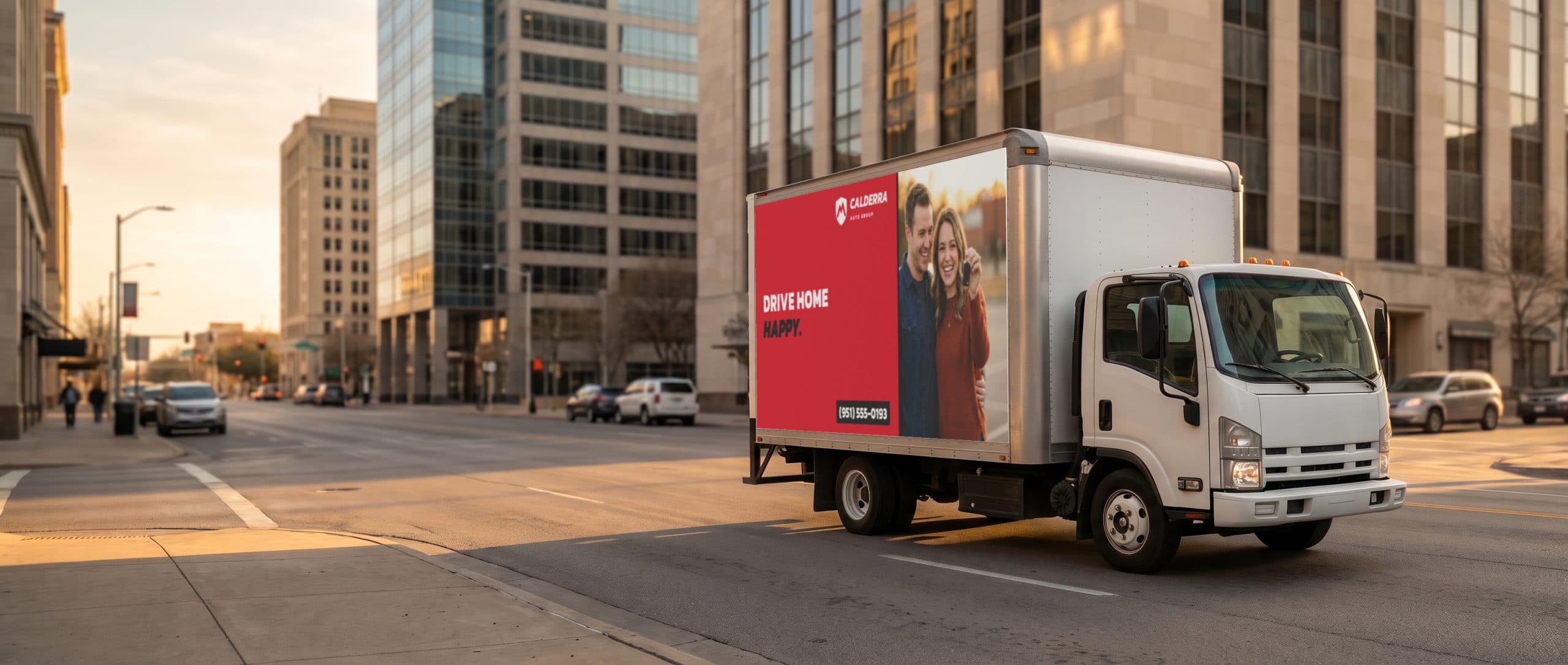
What is a mobile billboard truck?
A mobile billboard truck is a vehicle built to carry an ad and nothing else. It does not haul freight or make deliveries. You pay for it to drive, or sometimes park, where your customers are.
There are two kinds. A static truck carries a printed vinyl sign in a frame on the box. An LED truck carries a lit screen that can show moving images and rotate more than one ad. Some trucks carry the ad on more than one side. Billboard Express says its package puts your ad on three sides of the truck, and LED Truck Media prices dual- and triple-sided LED trucks separately from single-sided ones.
You will also see trailers: a sign on a towed, unpowered trailer. That difference matters more than it sounds, because California's legal definition of a mobile billboard is written around trailers and other unpowered devices. More on that in the rules section below.
People search for these under a lot of names: billboard trucks, moving billboard trucks, rolling billboards, advertising trucks, digital billboard trucks. They all mean the same basic thing. You rent a vehicle with an ad on it, for a set number of hours, on a route you agree on.
How does billboard truck rental work?
Here is the usual path from first call to the last day of the run. Every seller words it a little differently, so read the quote line by line.
- Pick the dates and hours. Most sellers price by the day, often counted as 8 hours. Billboard Express sells by the hour with an 8-hour daily minimum.
- Plan the route. You tell the seller where your customers are, and the seller builds a route and schedule around it. LED Truck Media lists route planning as part of a standard booking.
- Send the artwork. A static truck needs print-ready art, and the vinyl has to be printed and mounted. An LED truck needs a video or image file in the screen's size.
- The driver runs the route. LED Truck Media and Can't Miss US both say their rates include the driver and fuel.
- You get proof. The Rolling Ads says every campaign includes GPS live tracking and route logs. LED Truck Media lists GPS tracking and reporting. Billboard Express says GPS tracking and monitoring are included in the price.
Two things to get in writing before you pay. First, the exact streets and hours, so you can check them against the GPS report afterward. Second, what is extra. LED Truck Media lists permitting as part of a standard booking, and Can't Miss US says add-ons like retargeting carry separate fees. If the quote does not say, ask.
Then plan your follow-up. A truck that drives past a neighborhood for a day gives you one shot. Put a phone number or web address on the truck that appears nowhere else, so you can count what came from it.
How much does a mobile billboard truck cost?
There are two questions hiding in this one: what it costs to rent, and what it costs to buy. Most people mean rent.
Renting: priced by the day
Sellers publish more prices for this format than for most, and the ranges disagree. We show each one as the seller wrote it. We do not average them.
| What you rent | Published price | Source |
|---|---|---|
| Static truck, per day (8 hours) | $500 to $900 | The Rolling Ads, 2026 guide |
| LED truck, per day (8 hours) | $800 to $1,500 | The Rolling Ads, 2026 guide |
| Static truck, per day | $800 to $1,500 | LED Truck Media, March 2026 |
| Single-sided LED truck, per day | $1,500 to $3,000 | LED Truck Media, March 2026 |
| Dual- or triple-sided LED truck, per day | $2,500 to $5,000+ | LED Truck Media, March 2026 |
| Truck by the hour | $175 an hour, 8-hour daily minimum | Billboard Express rates |
| Truck, per day (typical range) | $1,200 to $4,000 | Can't Miss US cost page |
Seller prices as published on each page. Rates vary by market, hours and season. Get at least two quotes with the route and hours written in.
Longer runs usually lower the daily price. The Rolling Ads says weekly campaigns save 15 to 20 percent a day and monthly campaigns 25 to 30 percent. For monthly figures and printing costs, see our full mobile billboard rates page, and our truck advertising cost guide to compare trucks with wraps and bus ads.
Buying: priced by the build
Buying your own billboard truck is a different purchase. You pay for the chassis, the box or screen, and the build. Few sellers publish a number. One that does is The Rolling Ads, which lists a 2024 Isuzu NPR LED billboard truck for sale at $159,900. Treat that as one listing, not a market price, and get written quotes from builders. If a truck is more than your budget can carry, our guide to cheap billboard advertising covers lower-cost formats.
Static vs LED (digital) billboard trucks
This is the first choice you make, and it changes the price, the lead time and what you can show.
- Cost. In both seller tables that price them side by side, LED costs more per day than static.
- Print and lead time. A static truck needs vinyl printed and mounted before day one. The Rolling Ads puts that print at $300 to $800 and says LED campaigns have no separate production cost. An LED truck runs a file, so you can change the ad without printing anything.
- More than one message. An LED screen can rotate several ads, or show a different message in the morning and the evening. A static truck shows one design for the whole run.
- Night. A lit screen is easier to see after dark. A static sign depends on street light.
- Simplicity. A static truck is one big, plain message. That suits a phone number or a store opening that people should read in a few seconds.
Does anyone notice them? The best public number we found is a 2020 Nielsen survey for the outdoor industry. Among people 16 and older in the top 30 US markets, 31 percent said they had noticed a mobile digital billboard in the past month. That is a share of people who noticed one, in big markets, in 2020. It is not a count of people who saw any one truck, and it is not a promise for yours.
If you are torn, start with the message. One short line and a number works fine on vinyl. Several offers, a video, or a message that has to change by the hour points to LED.
Are mobile billboards legal? Where cities restrict them
Usually yes, but the rules are local, and they are stricter about parking than driving. Here is how it works in California, where the law is written down clearly. This is not legal advice. Check your own city's code before you book.
State law lets cities regulate them. California Vehicle Code section 21100(l) lets local authorities regulate mobile billboard advertising displays. That includes setting penalties, which can mean removing the display, civil fines and misdemeanor charges. For the full picture, see are mobile billboards legal in California.
The state definition is about trailers and devices. Vehicle Code section 395.5 defines a mobile billboard advertising display as an ad attached to a mobile, nonmotorized vehicle, device or bicycle that carries, pulls or transports a sign, and is mainly for advertising. In plain words, the law has towed sign trailers and similar devices in mind. A self-driven truck may be treated differently, so ask the seller and your city how their trucks are classed.
Los Angeles bars parking them. Los Angeles Municipal Code section 87.53 makes it unlawful to park a mobile billboard advertising display, standing alone or attached to a motor vehicle, on any public street or public land in the city. The city can remove it after a warning, and a repeat offense is a misdemeanor.
What this means for a renter:
- Plan a route that keeps moving, rather than a spot where the truck sits all day.
- If you want the truck parked at an event, ask about private lots and get the property owner's permission.
- Ask the seller what permits apply in your city and who pulls them. LED Truck Media lists permitting in its standard booking.
- Look up your own city's code. Rules in one city do not carry over to the next town.
How to plan a mobile billboard route
You are paying by the hour, so every hour should have a reason. Start from where your customers already are, then fill in the rest.
- Events. Game days, festivals, concerts and trade shows put a lot of people in one place for a few hours. Arrive before the crowd and loop the blocks around the venue.
- Openings and launches. A new store or office gets the most from a truck in the week it opens. Run the streets around the address and say the date.
- Areas you can't reach another way. If billboards are scarce or booked in a part of town, a truck can cover it for a few days.
- Repeat passes. One pass is easy to miss. Plan loops so the truck returns to the same streets at different times of day.
- Hours that match the message. Lunch offers at lunch. Commuter messages at rush hour. An LED truck can switch messages by time of day.
Then measure it. Put a phone number or short web address on the truck that you use nowhere else. Ask the seller for the GPS route report and compare it with when your calls came in. Add "How did you hear about us?" to every call. That gives you your own number, from your own phone, to judge the next booking by.
One habit worth copying: run the truck in one area and not another for the same days, then compare calls from each. A rented truck is one of the few outdoor formats where you control the route enough to run a clean test like that.
Rented truck vs an ad on a working fleet
A rented billboard truck is a burst you aim. You pick the streets and the hours, and you pay for every one of them. When the booking ends, the ad is gone.
An ad on a working fleet is the opposite deal. The trucks are already on the road doing their own job, and your ad rides along. You do not drive them around, and you do not choose their routes. What you get is time: the ad stays up for months, not days.
Freight fleets have sold this space for years. The Outdoor Advertising Association of America describes truckside displays as vinyl banners or films on frames on the sides and rear of trucks, in programs from one truck to 1,000 trucks on established routes, bought in one- to 52-week blocks. See our truck side advertising page for more.
City garbage trucks are another working fleet. The ad is a framed sign, not a wrap. The printed panel slides out of the frame and swaps in under 30 seconds, though a new message still goes through design, review and printing first. Trucks rotate through the city's collection routes, so you don't choose the route and there is no route guarantee. Roadway has built sign frames for refuse and recycling trucks since 1987. No city is open yet.
Some businesses will want both: a rented truck for an opening weekend, and a long-run panel for the rest of the year. See the five ways to get ads on trucks, read how garbage truck advertising works, or see your ad on a garbage truck.
Sources
- The Rolling Ads: Mobile billboard pricing guide, 2026 (seller)
- The Rolling Ads: Trucks for sale (seller)
- LED Truck Media: Mobile billboard advertising cost, March 2026 (seller)
- Billboard Express: Mobile billboard truck rates (seller)
- Can't Miss US: Mobile billboard advertising costs (seller)
- Nielsen: Digital Out-of-Home Advertising Report 2020, Top 30 Markets (p. 13)
- California Vehicle Code section 21100
- California Vehicle Code section 395.5
- Los Angeles Municipal Code section 87.53
- OAAA: Truckside and fleet displays
Written by
Roadway Displays
Roadway Ad Network is a business line of Roadway Displays, which has built sign frames for refuse and recycling trucks since 1987. We make the frames and print the panels ourselves.
Published · Updated · About us