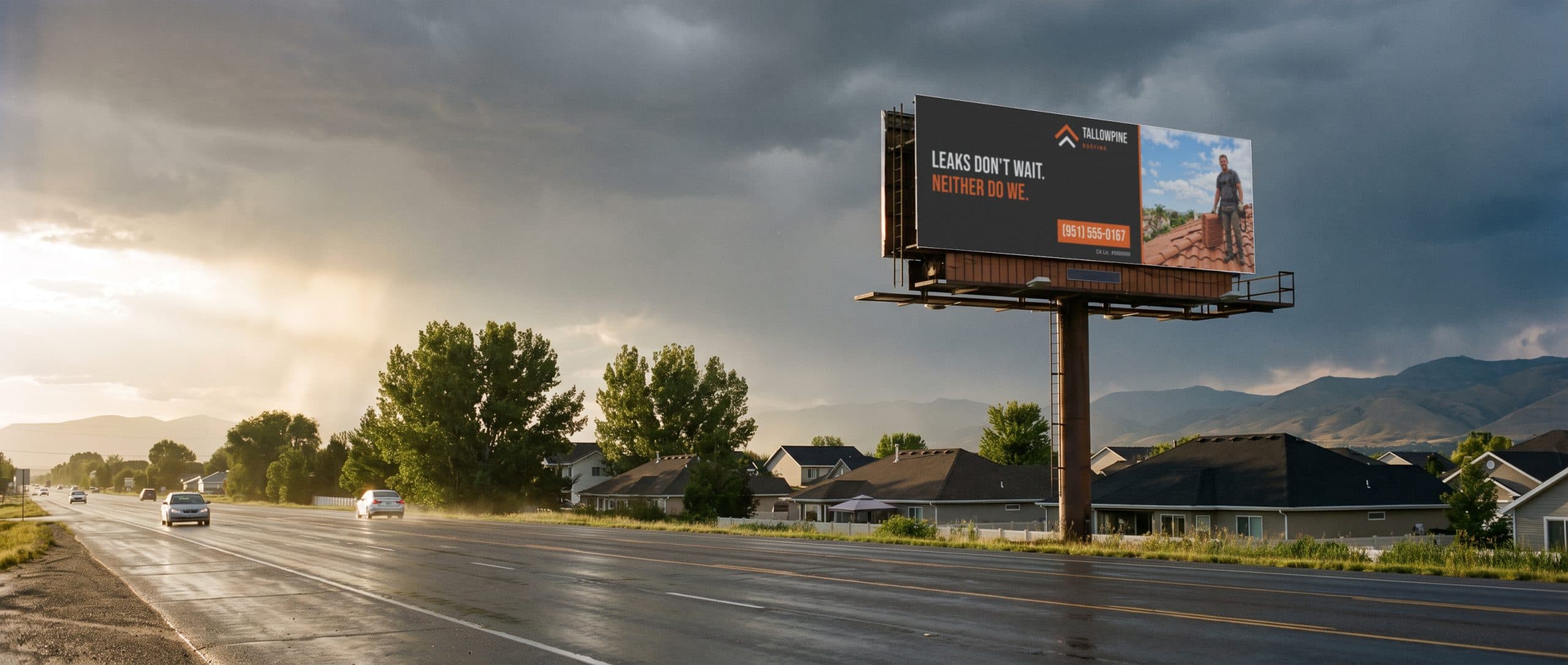
Do billboards work for roofing companies?
Nobody can tell you in general. There is no public dataset of roofing billboard results, and a return figure quoted without one is a guess. What a roofer can do is measure their own board, which is easier than most people think.
Start with what a billboard is good at. It puts your name and number in front of the same drivers week after week, long before their roof fails. When a homeowner finds a water stain on the ceiling, they search, ask a neighbor, or call a name they already know. A board helps with the third one. It rarely makes someone call the day they drive past it.
That's why a lot of roofers treat a board as one part of a mix. The board makes the name familiar. The Google profile, the reviews and the yard signs on finished jobs close the gap when the homeowner goes looking. If your reviews are thin, fix that first. A billboard sends people to check you out, and they'll judge you on what they find.
A billboard also asks for patience. One four-week period tells you very little. Plan for at least three periods, and decide in advance what number would make you renew.
For the wider question across every kind of business, read are billboards worth it.
How much does a roofing billboard cost?
Billboard prices don't change because the advertiser is a roofer. The board size, the market and the length of the run set the price. Here is what published sources list.
| Board type | Published price | Source |
|---|---|---|
| Static board (roofing guide) | $1,000 to $5,000 a month | JobNimbus |
| Junior poster (small) | $300 to $750 per 4 weeks | Blue Line Media |
| Poster (medium) | $750 to $4,000 per 4 weeks | Blue Line Media |
| Bulletin (large) | $1,500 to $30,000 per 4 weeks | Blue Line Media |
| Digital poster | $2,000 to $5,000 per 4 weeks | Blue Line Media |
| National average, any board | About $3,953 per 4-week cycle | Blindspot |
Prices as published by each source. Sellers' own figures; your market will differ.
Blindspot's guide gives a wider spread: $250 to $14,000 per cycle for static boards and $1,200 to $15,000 for digital, and reminds buyers that design, printing and installation sit on top of the rental for a static board. Many sellers also set a minimum. Blue Line Media lists $5,000 or more per market, which can be spread over boards and periods.
For a roofer, a small poster or junior poster on the roads into older neighborhoods is often a better first test than one big highway bulletin. You get a lower bill and a cleaner read on the calls.
Do you need a permit for a billboard?
Not if you're renting a face. In California, engaging in the business of outdoor advertising requires a Caltrans license, and displays need their own permits. That's the sign company's paperwork. For more on pricing, read billboard advertising, cheap billboard advertising and outdoor advertising cost.
What California requires on a contractor billboard
This is the part most roofing billboard articles skip. California's Contractors License Law sets rules for every ad a contractor runs, and a billboard counts.
The license number goes on the board
Section 7030.5 of the Business and Professions Code says every licensed contractor shall include the license number in all construction contracts, subcontracts and calls for bid, and all forms of advertising, as prescribed by the registrar. The registrar's regulation, 16 CCR 861, says advertising includes, among other things, any card, contract proposal, sign, billboard, lettering on vehicles, brochure, newspaper, magazine and electronic transmission. There's no gray area for a roofer's board.
Other lines the law draws
- Advertise inside your classification. Under section 7027.1, it's a misdemeanor to advertise for work unless you hold a valid license in the classification you advertise. Roofing is Class C-39. A C-39 roofer advertising solar installs or HVAC work would need those classifications too. Licensed A and B contractors may advertise as general contractors.
- Unlicensed operators. Section 7027.2 lets someone without a license advertise only for jobs under $1,000 in total, and only if the ad says they are not licensed. A roof replacement is far past that.
- Don't mention your bond. Under section 7071.13, a contractor's reference in advertising to a bond required by the Contractors License Law is a ground for suspending the license.
- No misleading home-improvement claims. Section 7161 makes false, misleading or deceptive advertising for home improvement work a misdemeanor and a cause for discipline.
The CSLB sums these up in its advertising guidelines and a 2020 industry bulletin reminding contractors to put the license number on vehicles and ads. Homeowners can check any number with the CSLB's Check A License lookup, so a board with a clear number also tells people you have nothing to hide.
One more rule matters after big storms. Under section 7028.16, contracting without a license to repair damage from a natural disaster, where the Governor has proclaimed a state of emergency or the President has declared an emergency or major disaster, is its own crime and can be punished with prison time. It's one more reason a visible license number helps a local roofer stand apart after a storm.
Not legal advice
This is a summary of public sources, not legal advice, and we don't review ads for legal compliance. Read the CSLB advertising guidelines and the code sections linked here, and ask the CSLB or your own counsel before a board goes up. Outside California, check your state's contractor licensing board.
When should a roofer run a billboard?
Before the weather turns, not after. A roof leak is an emergency, and the name a homeowner already knows has a head start. You want the board up during the weeks before the rain, while people are still thinking "I should get that looked at."
In California the calendar is clear. Researchers at UC San Diego's Center for Western Weather and Water Extremes note that about half of the state's annual precipitation arrives from December through February, and 90% falls between October 1 and April 30. For a California roofer, that points to a board that goes up in late summer or early fall and runs through the wet months.
Work backward from that date. Static boards are usually sold in 4-week cycles, and the vinyl has to be designed and printed before it's posted. If you want a board up by October, start talking to sellers in the summer.
Outside California, use your own market's calendar: the hail months, the hurricane season, or the first freeze. One roofing software guide suggests placing a board near older neighborhoods due for roof repairs, or along the routes into an area that just took a hailstorm. That second idea needs a format you can book fast. Blue Line Media notes that digital options may allow weekly or daily campaigns, depending on the market. A static board takes too long to print and post to chase a single storm.
Then plan the message for each season. A spring roof check, a "before the rain" inspection in the fall, and a leak-repair message in winter are three different boards. On a static board each change means new vinyl, so most roofers pick one message per season, not one per month.
What should a roofing billboard say?
Less than you want it to. A driver gets a few seconds with your board. Pick one message and make it easy to read from a moving car.
- One offer. "Free roof inspection" or "Leak repair, same week." Not a list of every service.
- Your company name. Big enough to read from the road.
- One phone number. A tracking number that rings your office and appears nowhere else.
- Your license number. Required in California. The billboard rule sets no type size, so it can be smaller than the phone number, but it has to be on the board.
- A photo only if it helps. A clean roofline reads fast. A busy before-and-after collage doesn't.
Watch the words you add for credibility. "Licensed" with your number is fine. "Bonded" runs into section 7071.13. Claims like "lowest price in town" or "lifetime roof" have to be true and backed up, because section 7161 treats misleading home-improvement ads as a misdemeanor. If the required lines crowd the design, cut the slogan before you shrink the number.
Roofing billboard ideas that tend to read well are plain: the offer in large type, the name, the number, high contrast, and plenty of empty space.
Cost per lead: the math, with example numbers
Example only
Every number in this section is made up to show the arithmetic. It is not a result from any roofer, any billboard or Roadway. Use your own numbers.
Here is how a roofer could score one board. Say a poster costs $2,500 per four-week period, the roofer runs it for three periods, and printing and posting add $500. Total spend: $8,000. The board's tracking line logs 20 calls. Twelve become inspections. Four become signed jobs.
| Step (made-up example) | Count | Cost each |
|---|---|---|
| Total spend, 3 periods plus print | $8,000 | n/a |
| Calls on the tracking number | 20 | $400 per call |
| Inspections booked | 12 | About $667 per inspection |
| Signed jobs | 4 | $2,000 per signed job |
Hypothetical numbers for illustration only. Not a result.
The number that matters is the last one. Compare the cost per signed job with what a signed job is worth to you after materials and labor, and with what a signed job costs you from other channels. If the board is in line or cheaper, renew it. If not, change the message or the location before you give up on the format.
How to set up the count
- Give each board its own phone number. One number per board, so two boards don't blur together.
- Ask every caller how they heard about you. People often call the main line from memory. The question catches some of them.
- Tag the source in your CRM. Keep the tag when the lead becomes an inspection and then a job.
- Do the division each period. Spend divided by calls, inspections and signed jobs.
- Decide after three or more periods. One month of roofing leads is mostly weather.
HVAC, plumbing and solar billboards
The same rules apply to every licensed contractor in California. An HVAC company, a plumber or a solar installer puts the license number on the board under section 7030.5, advertises only inside its classifications, and leaves the bond out.
Truck lettering is where the rules split. Plumbing (C-36), sign (C-45) and well-drilling (C-57) contractors must show their name, permanent business address and license number on each side of each commercially registered vehicle, in letters at least 1½ inches high, under section 7029.5. Every other contractor shows the business name and license number in or on each commercially registered vehicle used in the business, in a clearly visible location, in at least 72-point type or ¾ of an inch in height and width, under section 7029.6.
The timing logic carries over too, with a different calendar. An HVAC company might run a tune-up message before the first heat wave and a furnace check before the first cold night. Whatever the trade, pick the season, book the board ahead of it, and give it its own tracking number.
For trade pages, read HVAC advertising, plumbing advertising and solar advertising. For the same kind of rules in another trade, see law firm billboards.
Other outdoor options for roofers
A billboard isn't the only way to get your name on the road, and the license number goes on every one of these.
- Bus benches. Lower cost and close to neighborhoods. Read bus bench advertising.
- Mobile billboard trucks. Short runs, which can suit a fast storm response. Read billboard truck rental.
- Garbage truck panels. A framed sign, not a wrap. The printed panel slides out of the frame.
On a garbage truck panel the printed panel swaps in under 30 seconds, so a spring roof check and a fall leak message can share one spot. A new message still goes through design, review and printing first. In each city, every ad will be checked against that city's written ad policy before it runs, and our ad policy lists the California license number as a must-have for contractors.
There is no Roadway advertiser case study yet, and no city is open yet. Refuse trucks are not part of the industry's audited audience ratings, so any reach figure we show will be labeled as an estimate. Add a tracking number to your panel and count your own calls, the same way you would on a billboard.
To see how it would look, read roofing company advertising on city garbage trucks, learn how garbage truck advertising works, or see your ad on a garbage truck.
Sources
- California Legislative Information: Business and Professions Code section 7030.5
- Cal. Code of Regulations, Title 16, section 861: "Advertising" defined (via Cornell LII)
- California Legislative Information: Business and Professions Code section 7027.1
- California Legislative Information: Business and Professions Code section 7027.2 (amended 2024, AB 2622)
- California Legislative Information: Business and Professions Code section 7071.13
- California Legislative Information: Business and Professions Code section 7161
- California Legislative Information: Business and Professions Code section 7028.16
- California Legislative Information: Business and Professions Code section 7029.5
- California Legislative Information: Business and Professions Code section 7029.6
- Cal. Code of Regulations, Title 16, section 832.39: Class C-39 Roofing Contractor (via Cornell LII)
- Contractors State License Board: Advertising Guidelines for Contractors (PDF)
- Contractors State License Board: Industry Bulletin 20-21, license number on vehicles and ads, Sep 17 2020 (PDF)
- Contractors State License Board: Check A License
- CW3E, UC San Diego: California precipitation seasonality (PDF)
- Caltrans: Outdoor Advertising program
- Blue Line Media (seller): Billboard advertising rates
- Blindspot (seller): How much does a billboard cost, July 2026
- JobNimbus (roofing software publisher): Roofing billboards, August 2026
Written by
Roadway Displays
Roadway Ad Network is a business line of Roadway Displays, which has built sign frames for refuse and recycling trucks since 1987. We make the frames and print the panels ourselves.
Published · Updated · About us