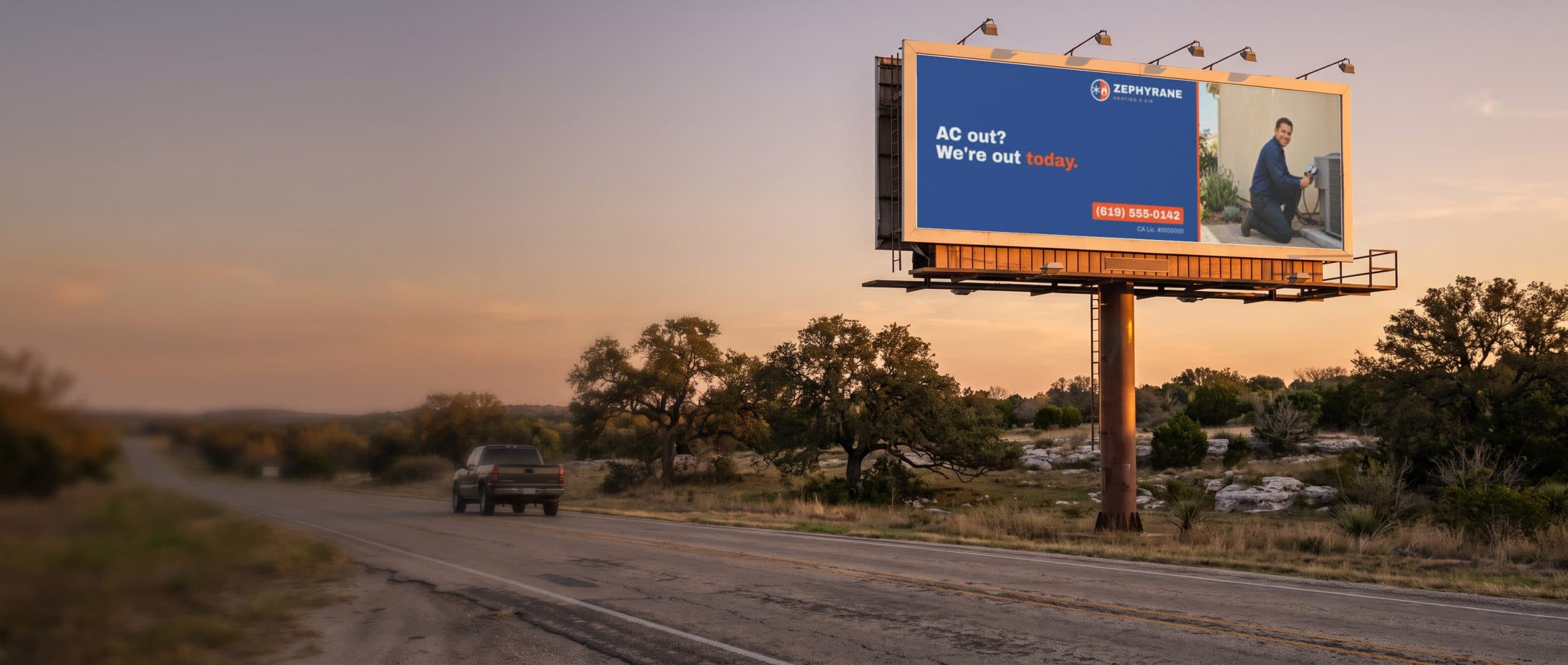
Are billboards effective?
Billboards can be effective, but not for everyone. They work best when the message is short, the board sits on a road your buyers drive often, and you can pay for enough months that people see it again and again.
They tend to fail for the opposite reasons. The offer takes a paragraph to explain. The board sits on a road your customers rarely use. Or the owner buys one month, hears nothing, and calls it a loss without ever counting a single call.
You will find a lot of big numbers online about billboard returns. Most of them have no source. The research that does exist is mostly paid for by the industry itself, which does not make it wrong, but you should know who paid for it.
Here is one example. In May 2026 the OAAA, the out-of-home industry's trade group, published a study with the analytics firm Kochava. It was funded by the Foundation for Outdoor Advertising Research and Education, an industry foundation. The OAAA says out-of-home ads delivered a median lift of 20% for in-person outcomes, such as store visits, and 14% for digital outcomes, against about 10% for connected TV and broadcast TV. That is an industry-funded result across many brands. It tells you outdoor ads can move people. It does not tell you what one board on your street will do for your business.
So the answer is: billboards work when the basics are right, and the only proof that counts is your own. The rest of this guide is about getting the basics right and measuring the result.
What makes a billboard work, and what makes one fail
The message
Drivers get a glance, not a read. A board that works usually carries three things: your name, what you do, and one way to reach you, like a short phone number or a web address. Every extra line competes with the road. If your offer needs fine print, a billboard is the wrong place to explain it.
The location
A busy road is not the same as the right road. A plumber wants the roads people in their service area drive every day. A personal injury firm may want a highway with long sight lines. Before you sign, drive past the board yourself at the hours your customers would. Ask the seller which way it faces, how long it stays in view, and what else is near it.
The length of the run
Static billboards are typically sold in four-week posting periods, according to the agency Blue Line Media, with shorter terms in some markets at a premium. Blindspot describes the same four-week (28-day) cycle. That cycle is the floor, not the goal. A board works through repetition, so plan the budget for several cycles.
A common way to lose money
One four-week run, a long phone number nobody can remember from a moving car, and no way to tell which calls came from the board. At the end of the month there is nothing to measure, so the owner decides billboards do not work. The board never had a fair test.
How many impressions does a billboard get?
There is no single number. Every board has its own audience estimate, and it depends on the road, the traffic, which way the board faces and whether it is lit. A board on a freeway and a board on a side street are not in the same league.
Most sellers quote impressions from Geopath, the industry's audience measurement body. Geopath defines impressions as the total number of times people passing a display are likely to notice the ad. Notice the word likely. Geopath starts with everyone who passes (the opportunity to see) and then adjusts for how visible the board is, to estimate how many are likely to see it.
Lighting changes the count. Geopath counts an unlit board over 12 hours, 6am to 6pm. A lit board is counted over 18 hours, to midnight, or over 24. So a lit board can show a bigger number partly because it is counted over more hours.
Two more things to keep in mind. An impression is not a person. If the same commuter drives past twice a day for four weeks, that can add up to dozens of impressions from one driver. Geopath tracks that separately as reach (the share of people who notice the ad at least once) and frequency (how many times, on average). And an impression is a model, not a headcount. Nobody stood by the road and counted heads turning.
When a seller gives you a number, ask three questions:
- What is the board's rated weekly impression count, and is it for this exact board or an average?
- Who measured it, Geopath or the seller's own estimate?
- When was it last updated? Traffic patterns change when roads, stores and offices change.
Then treat the answer as a way to compare boards with each other, not as a count of customers.
How do you measure whether a billboard worked?
You measure it yourself. The seller can tell you how many people likely passed. Only you can tell how many of them called. Set this up before the board goes live, not after.
- Give the board its own phone number. Use a call-tracking number that rings your main line, so every call on it came from the board.
- Give it its own web address. A short, easy address that points to a page on your site, so visits from the board show up separately in your analytics.
- Ask every new customer how they heard about you. Write it down at intake. People mix up formats, so treat this as a backup, not the main count.
- Compare the same months year over year. If you are busier every spring, compare this April to last April, not to March.
Give it time. One month is a short test for a format built on repetition. Two or three months of tracked calls and visits will tell you far more than any rating sheet.
Then do the simple math. Take what you paid, including printing, and divide it by the new customers you can trace to the board. That is your cost per customer. Compare it to what you pay for a customer from your other advertising. If the board is in the same range or better, it is earning its place.
Are billboards worth it for a small business?
Start with the price. Blindspot, which sells digital billboard time, puts static billboards at $250 to $14,000 per four-week cycle and digital at $1,200 to $15,000, with a national average of roughly $3,953 per cycle. Blue Line Media lists large bulletins at $1,500 to $30,000 per four weeks and notes a minimum purchase of $5,000 or more per market. For more, see the full billboard prices and our guide to outdoor advertising cost by format.
The space is not the whole bill. On static boards, Blindspot notes, design, printing and installation come on top of the media fee.
Now the question that decides it: how many new customers does the board need to bring in to pay for itself? The formula is simple.
The break-even formula
Monthly cost ÷ gross profit per new customer = customers needed to break even each month.
Example, not a quote
Take Blindspot's national average of $3,953 per four-week cycle. Say one job earns you $1,000 in gross profit (a made-up number; use your own). $3,953 ÷ $1,000 is about 4. The board needs to bring in roughly four new jobs every four weeks just to break even, before printing. If one customer comes back for years, count what they are worth over that time, not just the first job.
Run the numbers with your own price and your own profit per job. If the answer is two customers a month and you sell high-ticket work, a board can make sense. If the answer is 40 and you sell a $50 service, it probably will not, no matter how good the location is.
Two last checks. Can you afford to keep it up for several months? And can you track it? If either answer is no, put the money somewhere you can measure, or look at cheaper billboard options first.
Are digital billboards more effective than static ones?
Neither is more effective across the board. They are bought differently. A static board shows your ad all day, every day, for the whole run. A digital billboard rotates several advertisers in a loop, so you buy a share of the screen time. Blip, a self-serve seller, sells plays of 8 seconds each.
Digital has real advantages. You can change the message quickly, and in many markets run weekly or even daily, according to Blue Line Media. Static boards need new printed art, and Blue Line asks for static art two to three weeks before the start date.
People do notice digital boards. In Nielsen's 2020 digital out-of-home report, an online survey of 453 people age 16 and older in the top 30 US markets, 62% said they had noticed digital billboards in the past month and 38% in the past week. That is noticing, in big cities, in early 2020. It is not a promise anyone will remember your ad.
The choice comes down to your message and schedule. A full-time face suits one steady message. A share of a digital loop suits a business that wants to change offers often or only needs certain hours.
Disadvantages of billboards, and where they are banned
Billboards have real downsides. Know them before you sign.
- High minimums. Blue Line Media lists a minimum purchase of $5,000 or more per market, depending on the market.
- Four-week buying. Static boards are sold in four-week periods, so a short test is hard to buy.
- Slow message changes on static boards. New art means new printing and a new install.
- No control over who drives by. You pay for everyone on the road, not just your buyers.
- Waiting lists. The best faces are often booked, so the board you want may not be open.
- Production on top. Design, printing and installation are usually extra on static boards.
Some places limit new boards altogether. According to Scenic America, Alaska, Hawaii, Vermont and Maine prohibit new billboard construction. Vermont did it in 1968. Oregon has a cap-and-replace law: no new billboard goes up until an existing one comes down. Scenic America also estimates that about 700 communities have billboard bans of their own. Along interstates and primary highways, federal law has controlled outdoor signs since the Highway Beautification Act of 1965, according to the Federal Highway Administration.
Are billboards becoming obsolete? Not by the spending numbers. The OAAA reports US out-of-home ad spend grew 3.6% to $9.46 billion in 2025, billboards grew 2.3%, and digital out-of-home grew 10.5% and made up about 36% of the total. Billboards are changing more than they are disappearing.
What to use when a billboard doesn't fit
Sometimes the math does not work, the right board is taken, or your buyers are on neighborhood streets, not highways. These formats do some of the same job at street level, and each is bought differently.
| Format | Where it sits | How it's bought | Learn more |
|---|---|---|---|
| Bus bench | At bus stops, at curb level | Per bench, usually in four-week periods | Bus bench advertising |
| Bus shelter | On the panels of a bus stop shelter | Per panel, per month or four weeks | Bus shelter advertising |
| Bus exterior | On the side or back of a city bus | Per bus, per month, from transit rate cards | Advertising on buses |
| Mobile billboard truck | A rented truck drives a route you choose | Per day or per campaign | Billboard truck rental |
| Garbage truck panel | A framed panel on a city collection truck | City by city; no city is open yet | Garbage truck advertising |
How each format is usually bought. Check each seller for current terms.
The last row is ours, so here is what it is, plainly. A garbage truck panel is a framed sign, not a wrap. The printed panel slides out of the frame and swaps in under 30 seconds. A new message still goes through design, review and printing first. Trucks rotate through the city's collection routes, so there is no route guarantee.
It is an addition to a billboard, not a replacement. Refuse trucks are not part of the industry's audited audience ratings (Geopath), so any reach figure we show is labeled as an estimate. Nothing to skip. Nothing to block. Add a tracking number to your panel and count your own calls, the same way you would on a board. No city is open yet. Until then, you can see what your ad looks like on a truck.
Sources
- Geopath: Glossary (impressions, illuminated and un-illuminated units, reach, frequency)
- Geopath: Transit FAQs (media types Geopath audits)
- OAAA: OOH delivers 2x the performance lift of TV, new OAAA and Kochava study finds (May 2026; sponsored by FOARE)
- OAAA: 2025 OOH Facts & Figures, Ad Spend Performance
- Nielsen: Digital Out-of-Home Advertising Report 2020, Top 30 Markets (hosted by Meadow Outdoor)
- Blindspot (seller): How much does a billboard cost (updated July 2026)
- Blue Line Media: Billboard advertising (agency publication)
- Blip (seller): Digital billboard pricing
- Scenic America: Model legislation for banning billboards
- Scenic America: Case study, Vermont's billboard ban
- Federal Highway Administration: Outdoor Advertising Control
Written by
Roadway Displays
Roadway Ad Network is a business line of Roadway Displays, which has built sign frames for refuse and recycling trucks since 1987. We make the frames and print the panels ourselves.
Published · Updated · About us