How can I advertise my business locally for free?
Two kinds of free promotion work for a local business. The first is being listed everywhere people look up a business on their phone: Google, Bing, Apple Maps and Nextdoor. The second is showing up in person, where people in your town already gather and talk.
Neither costs ad money. Both cost time, and they keep costing time, because a listing nobody updates and a chamber membership nobody uses don't do much. Here's what each free channel gives you, taken from the platform's own pages.
| Channel | Cost | What you get | Source |
|---|---|---|---|
| Google Business Profile | Free | Your hours, phone, photos, reviews and posts on Search and Maps | |
| Bing Places for Business | Free | A listing in Bing search results and Bing Maps; import from Google | Bing |
| Apple Business (formerly Business Connect) | Free | Your place card in Apple Maps, with photos, hours and offers | Apple |
| Nextdoor Business Page | Free | A page neighbors can recommend, plus free posts to nearby neighborhoods | Nextdoor |
| Customer reviews | Free to ask | Reviews next to your profile on Maps and Search | |
| Local press, chamber, partners, signs | Your time | Name recognition in your own town | This guide |
Each listing also sells optional paid ads. The listing itself is free, per each platform's own page.
This guide stays on the free side. For paid options like mail, radio, community papers, sponsorships and outdoor ads, with published prices, read how to advertise a small business locally.
Start with your Google Business Profile
Google says that with a Business Profile you can manage how your business shows up on Maps and Search at no charge. The profile shows your hours, website, phone number and location, plus photos and videos of your work. Customers can leave reviews, and you can reply to them.
Most owners set it up once and forget it. The part people skip is posts. Google lets you publish updates, offers and events that show on your profile in Search and Maps. An offer needs a title and dates. Posts older than six months are archived unless you set a date range, so a profile with one post from two years ago looks quiet. One more catch from the same page: a post with a phone number in it might be rejected if Google can't confirm the number belongs to your business.
If you work out of a truck, not a storefront
Plumbers, cleaners, roofers and other trades that go to the customer are what Google calls service-area businesses. Google's rule is direct: if you don't serve customers at your business address, remove the address from your profile and list a service area instead. You can set up to 20 service areas by city or ZIP code, and Google says the whole area shouldn't run more than about two hours' drive from your base.
- Fill in every field. Categories, services, hours, holiday hours, a real description.
- Add new photos regularly. Your crew, your trucks, finished jobs. Real photos beat stock.
- Post something every few weeks. A finished job, a seasonal reminder, an offer with dates.
- Reply to every review. Short and specific, good or bad.
Bing Places, Apple Business and Nextdoor
Google isn't the only map on people's phones. Three more listings are free, and between them they cover Windows search, iPhone maps and your neighbors' feeds. Claiming all three takes an afternoon.
Bing Places for Business
Microsoft says you can list your business on Bing for free. Bing Places is a free platform for listings in Bing search results and Bing Maps, and Microsoft rebuilt it in October 2025 with a faster way to import your listing from Google, keeping your name, hours and contact details. The address also moved from bingplaces.com to bing.com/forbusiness. If your Google profile is already complete, importing it is the quickest win in this guide.
Apple Business (formerly Apple Business Connect)
Apple launched Business Connect in 2023 as a free tool for claiming your place card in Apple Maps. On April 14, 2026, Apple folded it into a new platform called Apple Business, which Apple describes as a free service, and moved existing claimed locations over automatically. You can add photos, hours and location details to your place card, and use Showcases to feature deals or seasonal items. The paid part is separate: Apple announced ads on Maps for businesses in the US and Canada starting in summer 2026. You need to claim your location first either way.
Nextdoor Business Page
Nextdoor says it creates business pages automatically for local businesses, so neighbors may already be recommending you, or asking about you, on a page you've never seen. Claiming it is free. Nextdoor lists what the free Business Page includes: collecting recommendations and "Faves" from neighbors, replying to messages, and unlimited free posts. When you post, you choose the radius or the specific neighborhoods that see it. One limit from the same page: casual service providers, like dog walkers or babysitters, need official business documents to verify the page before they can post to the neighborhood feed. Nextdoor also sells ads; they're optional.
How do I get more reviews without breaking the rules?
Ask. That's most of it. Google's own advice is to remind customers to leave reviews by sending them a review link or showing a QR code, and to reply to the reviews you get. Google also says a mix of positive and negative feedback often feels more trustworthy, so one bad review isn't the end of the world.
What you can't do is buy them, even with a small favor. Google's policy says merchants may not offer payment, discounts, free goods or services in exchange for a review, ask only happy customers, or pressure people to review while they're still on site. The federal government has a rule on this too. The FTC's rule on consumer reviews and testimonials took effect on October 21, 2024. It bans fake reviews, incentives tied to a review saying something positive or negative, undisclosed reviews by company insiders, and using threats to get a negative review taken down.
- Ask every customer, not just the happy ones. Same message, same link, every job.
- Make it one tap. Send the review link by text right after the job, or print the QR code on your invoice.
- Offer nothing for it. No discount, no raffle entry, no free add-on.
- Don't write reviews for yourself, your staff or your family. And don't ask them to.
- Reply to every review, including the bad ones. Keep it short, stay polite, offer to take it offline.
Not legal advice
This is a summary of Google's published policy and the FTC's rule as written. If you're unsure whether a review practice crosses a line, read the FTC's question-and-answer page or ask a lawyer.
Free ways to promote your business offline
Listings help people who are already searching. The offline side is how people who aren't searching yet learn your name. It's slower, but it's where word of mouth starts.
Local press
Community papers, local news sites and neighborhood newsletters need local stories. A new location, a milestone, a hire from the local high school, a cleanup your crew did for free: those are stories. "We're having a sale" isn't. Send a short note to the editor with the who, what, when and a good photo, and expect most pitches to go nowhere. The one that runs is free coverage.
Chamber of commerce and community events
Chamber membership may come with dues, so ask what non-members can attend before you join. Mixers, ribbon cuttings and community events put you in a room with other owners who refer work. Volunteering at a school fundraiser or a park cleanup puts you next to the families you want as customers. Show up more than once. People refer businesses they recognize.
Partner businesses
Find businesses whose customers need you next. A real estate agent and a home inspector. A pool builder and a pool cleaner. A dentist and an orthodontist. Agree to pass each other's cards along and mean it. A stack of your cards on a partner's counter is free, and a referral comes from someone the customer already trusts.
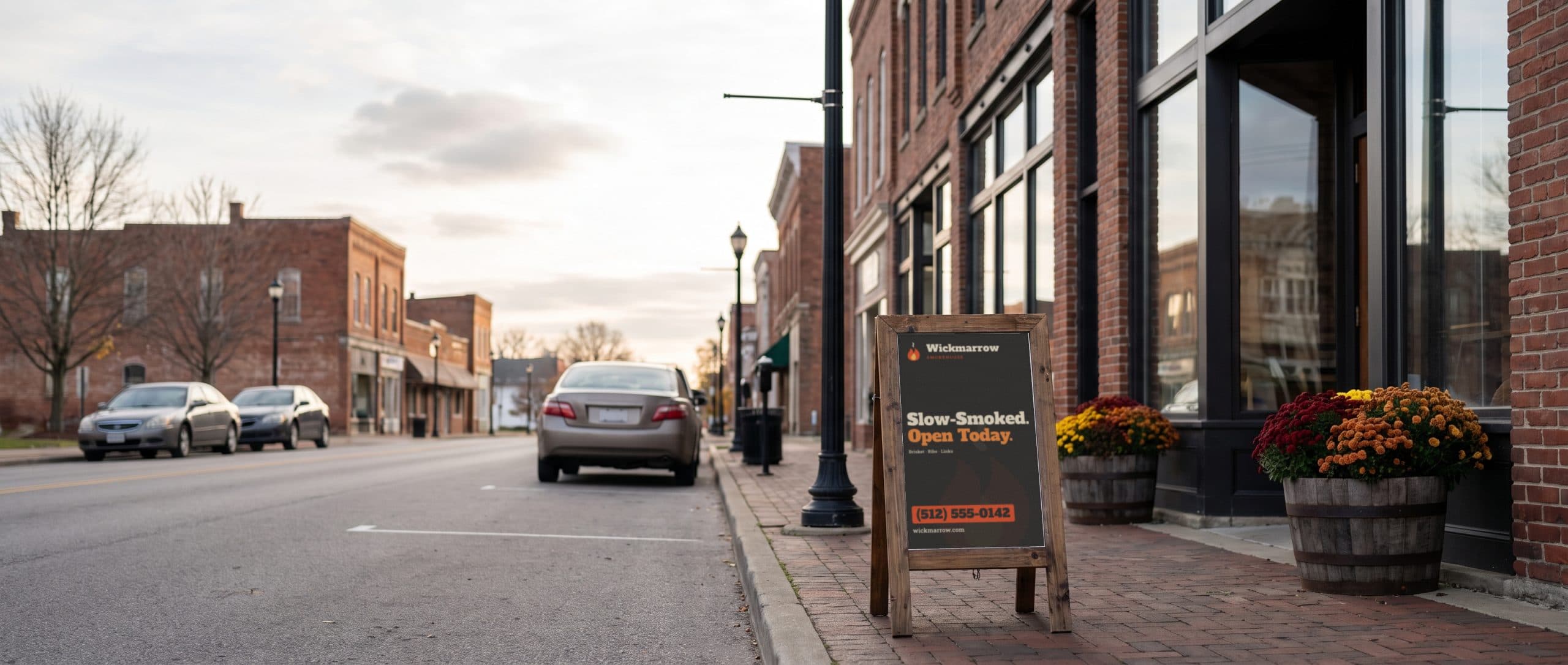
Yard and window signs where they're allowed
Your own windows, your own building and your own work truck are free sign space you already have. A job-site sign in a customer's yard, with their permission, tells the whole street who did the work. What you can't do is staple flyers to poles. In California, Penal Code 556 makes it a misdemeanor to put advertising on state, city or county property without lawful permission, and Penal Code 556.1 covers property you have no right to possess, without the consent of the owner, lessee or person in lawful possession.
City sign codes and HOA rules can limit size, placement and how long a sign stays up, so check both. California contractors have one more line to include: B&P Code 7030.5 requires a licensee's license number in all forms of advertising, as prescribed by the registrar of contractors. Our roofing company billboards guide covers that rule in more depth, and billboard design has tips for short copy that reads from the street. Not legal advice.
What free promotion can't do
Free channels have real limits, and it's better to know them going in. None of these tactics comes with a guarantee, and none of the platforms promises you calls.
- Listings wait for a search. Your Google, Bing and Apple listings show up when someone looks for what you sell. They don't reach the homeowner whose roof is fine today.
- Reviews build slowly. You can ask every customer, but you can't control how many write one or when.
- Posts reach people on the platform. A Nextdoor post reaches neighbors who use Nextdoor. Everyone else misses it.
- Your time isn't free. An hour a week on listings and posts is an hour not spent on jobs. Track what brings customers and drop what doesn't.
- You don't control the space. Platforms change their features and rules. Apple renaming Business Connect in 2026 is a recent example.
Search catches demand that already exists. If you need more people to know your name before they need you, that's where paid advertising comes in.
When does it make sense to add paid local advertising?
Don't pay to send people to a profile with three photos and no reviews. Fix the free basics first. Then paid ads start to make sense when most of these are true:
- Your free listings are complete on Google, Bing, Apple and Nextdoor, with recent photos and replies to reviews.
- You can hold a fixed monthly number for at least three months, printing and setup included. One month of anything tells you very little.
- You can track it. A phone number, promo code or web address that appears only in that ad.
- You know roughly what a customer is worth, so you know what you can afford to pay to get one.
- You serve a defined area and want people there to recognize your name before they need you.
For the paid options, from mailers and community papers to radio, sponsorships and outdoor ads, with published prices for each, read how to advertise a small business locally. If outdoor is on your list, cheap billboard advertising covers the lower-cost ways in, and how to budget your first outdoor campaign walks through the numbers.
Where a street-level format fits
Street-level ads are the paid version of a sign in your own window: your name where people in your area already are. That includes bus bench ads, billboards, a wrap on your own work truck and the other formats in our types of outdoor advertising. They suit a business with a service area that can run for several months. They're weak for a one-day sale.
Garbage truck advertising is one of those formats: a framed sign on the side of a city refuse truck, not a wrap. The printed panel slides out of the frame, and it swaps in under 30 seconds. A new message still goes through design, review and printing first. In each city, every ad will be checked against that city's written ad policy before it runs.
Talk to us for pricing. No city is open yet, and there is no Roadway advertiser case study yet. Refuse trucks are not part of the industry's audited audience ratings (Geopath), so any reach figure we show will be labeled as an estimate, with how we got it. Add a tracking number to your panel and count your own calls, the same way you'd track any channel in this guide. To see where it could fit, read how garbage truck advertising works, join the list for your city, or see your ad on a garbage truck.
Sources
- Google: Business Profile (free listing)
- Google Business Profile Help: About Business Profiles
- Google Business Profile Help: Create and manage posts
- Google Business Profile Help: Manage service areas
- Google Business Profile Help: Tips to get more reviews
- Google Maps User Generated Content Policy: Prohibited and restricted content
- Microsoft (seller): Bing Places for Business
- Microsoft Bing Blog: Introducing the new Bing Places for Business, October 3, 2025
- Apple Newsroom: Introducing Apple Business, March 24, 2026
- Apple Newsroom: Introducing Apple Business Connect, January 11, 2023
- Nextdoor (seller): Create your Business Page
- Nextdoor Help: Claim or create your business page
- Federal Trade Commission: The Consumer Reviews and Testimonials Rule, Questions and Answers
- Federal Trade Commission: Final rule banning fake reviews and testimonials, August 14, 2024
- California Penal Code section 556 (leginfo)
- California Penal Code section 556.1 (leginfo)
- California Business and Professions Code section 7030.5 (leginfo)
Written by
Roadway Displays
Roadway Ad Network is a business line of Roadway Displays, which has built sign frames for refuse and recycling trucks since 1987. We make the frames and print the panels ourselves.
Published · Updated · About us