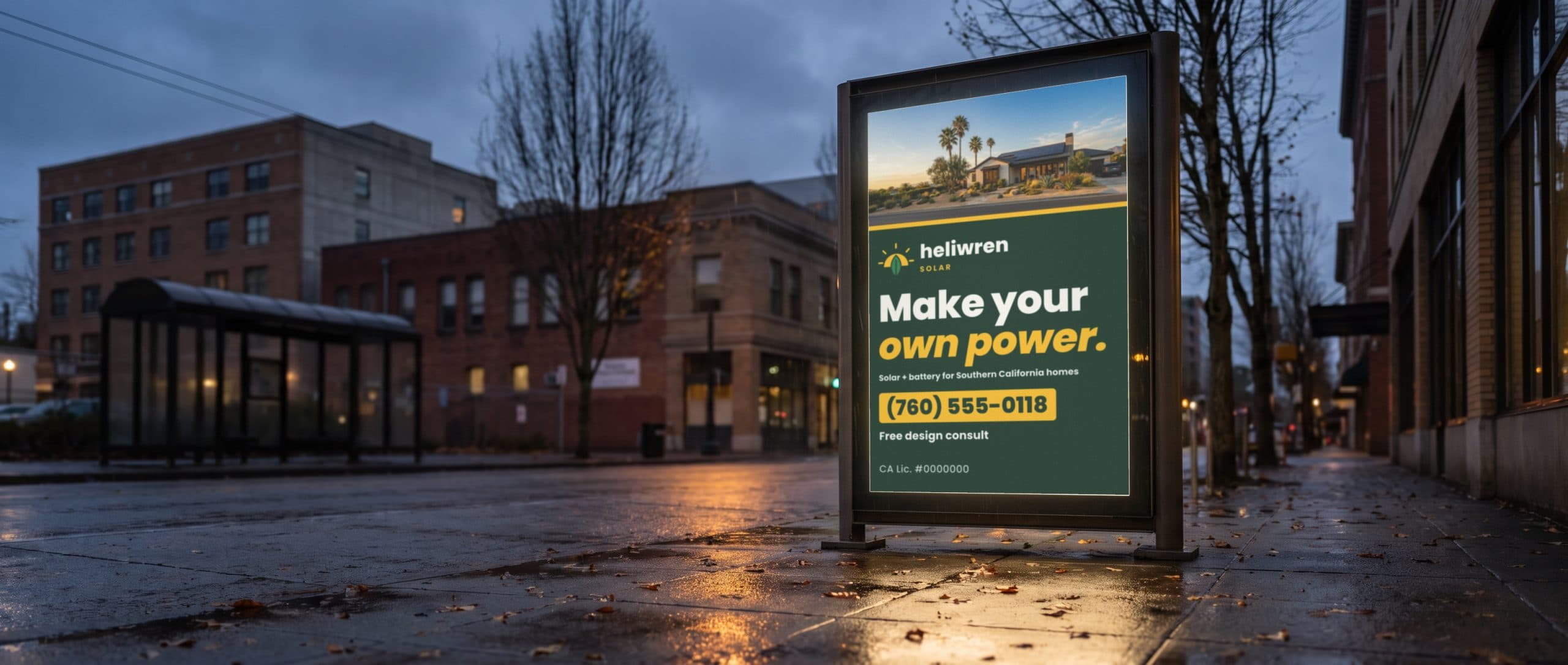
What is street furniture advertising?
Street furniture is anything a city puts on the sidewalk for public use. Shelters to wait in, benches to sit on, kiosks with maps, stands that sell newspapers, public toilets. When one of those fixtures carries a paid ad, that's street furniture advertising.
It's a big family of formats, and most of them work the same way behind the scenes. Here are the common ones, with where to go for prices:
- Bus shelters. Backlit panels on the shelter walls, static or digital. Prices and rate cards are on our bus shelter advertising page.
- Benches. A printed panel on the bench back. Costs and who sells them are in bus bench advertising.
- Kiosks. Freestanding units with a map or touchscreen on one side and an ad on the other. Many are now digital screens.
- Newsstands and newsracks. Ad panels on the sides of the stand or the rack.
- City information panels. Map and wayfinding panels with an ad face on the back.
- Public toilets and bike shelters. Larger structures some cities include in the same contract.
- Trash and recycling cans. Covered in advertising on trash cans.
Sellers group these the same way. JCDecaux (seller) lists bus shelters, newsstands, city information panels and kiosks. Outfront (seller) lists bus shelters, kiosks, bike shares, urban panels and metro lights. Clear Channel Outdoor (seller) lists benches and newsracks.
This page doesn't repeat the price tables on those format pages. It covers what sits above all of them: the city contract that decides who builds the furniture, who sells the ads, and what the city gets back.
How do cities sell street furniture advertising?
Mostly, they don't sell it themselves. The sidewalk belongs to the city, so the city decides what goes on it. But instead of buying shelters and kiosks and hiring a sales team, most big cities sign one long contract with one company.
New York's version is a good template. In July 2005, after a competitive bid, the city's transportation department awarded a coordinated street furniture franchise to Cemusa to design, manufacture, install and maintain the furniture at no cost to the city. The same agreement lets the company sell advertising on the structures "within clearly defined limits." JCDecaux (seller) bought Cemusa in late 2015 and continued the deal under an amended agreement.
Most of these contracts share the same parts:
- A franchise or concession. The right to put ad-bearing furniture in the public right of way, usually for one company, for a long term.
- Furniture at no cost to the city. The company pays to build, clean, repair and replace it.
- Payment to the city. A fixed annual fee, a share of ad revenue, or both.
- City time on the screens. Space for public service messages, maps or emergency alerts.
- Content rules. A written list of what ads can't say or sell.
- A long term. Boston's first program ran about 25 years. IKE Smart City's (seller) Fort Lauderdale proposal asks for 10 years plus a 10-year renewal.
Some cities also have to change their own sign rules before any of this is allowed. Austin's council approved an ordinance amending City Code Chapter 25-10 in March 2026 so interactive digital kiosks could go in the public right of way.
Which cities run street furniture ad programs?
Here are five public records, each described from the city's own page or a public filing. Programs change, contracts expire and new ones get bid, so check the current record before you plan around any of them.
| City | What's covered | Company | City's side | Source |
|---|---|---|---|---|
| New York, NY | Bus shelters, newsstands, automatic public toilets, bike shelters | JCDecaux (seller) | Furniture built and maintained at no cost; ads within set limits | NYC DOT |
| New York, NY | LinkNYC kiosks that replaced payphones, with digital ad screens | CityBridge consortium; ads sold by Intersection (seller) | Built at no cost; $20 million minimum annual guarantee in year one | NYS Comptroller audit; NYC OTI |
| Boston, MA | Bus shelters, info panels, newsstands, digital billboards, public toilets | JCDecaux (seller), through 2026 | $36,637,430 to the city to date; new RFP due Nov 4, 2026 | Boston.gov |
| Austin, TX | Interactive digital kiosks downtown | IKE Smart City (seller) | Zero cost to the city; ad revenue shared with the city | City of Austin |
| Fort Lauderdale, FL | Proposed: 30 interactive kiosks | IKE Smart City (seller), unsolicited proposal | Proposed 20% of net revenue in years 1 and 2, 35% after | Proposal filed with the city |
Each row is a public fact about that city's own program or a proposal filed with it. Fort Lauderdale's row is the vendor's proposal, not an approved contract.
New York: two franchises on the same sidewalks
New York runs street furniture through two separate deals. The transportation department's franchise covers more than 3,300 bus shelters, newsstands, up to 40 automatic public toilets and bike shelters. The technology office runs LinkNYC, which launched in 2015 to replace payphones with kiosks offering free Wi-Fi, calls and charging, plus digital ad screens, at no cost to taxpayers.
LinkNYC also shows how these deals can go wrong. A 2021 New York State Comptroller audit found the city hadn't collected almost $70 million due from the operator, and that far fewer kiosks were installed than the schedule required. The franchise was amended in 2021, and it now requires 90% of new kiosks to go in the outer boroughs and above 96th Street in Manhattan.
Boston: the end of a 25-year program
Boston launched its program in 2001. The city's page says JCDecaux runs it until 2026 at no cost to the city, and it has generated $36,637,430 for the city. In September 2026 Boston released a new RFP for bus shelters, wayfinding kiosks and other furniture, to be "self-sustaining through advertising revenue." Proposals are due November 4, 2026.
Where does the money go?
Cities sign these deals for two reasons: they get furniture they'd otherwise have to buy and maintain, and they get paid. How they get paid varies.
- A guaranteed minimum. LinkNYC's agreement carried a $20 million minimum annual guarantee for its first year, and the program was projected to generate over $500 million in revenue in its first 12 years.
- A share of net revenue. IKE Smart City's (seller) Fort Lauderdale proposal offers 20% of net revenue in years 1 and 2 and 35% in years 3 to 20. Net means after the company takes a 12.5% sales and management expense plus power, data, insurance, taxes, depreciation and maintenance.
- Airtime instead of cash. The same proposal gives the city at least 12.5% of advertising time for civic messages, plus unsold time when available.
None of these numbers is what an advertiser pays. A city's share is cut from the seller's total revenue across every face, after the seller's costs. Your price comes from the seller's rate card, the location and the length of the run.
The model is also growing. Boston's release, citing the industry's trade group, says street furniture ad revenue grew 11.5% year over year in the first quarter of 2026.
What can't run on street furniture ads?
Because the furniture sits on public property, the city writes limits into the contract. Each city sets its own.
New York's franchise allows ads only within clearly defined limits. Austin says all advertising content will be subject to City guidelines and approval. In its Fort Lauderdale proposal, IKE Smart City (seller) lists categories it won't advertise, including tobacco, firearms, sexual services, and political candidates or issues, and says the final list is agreed with the city.
Self-service platforms add their own rules. LinkNYC's portal says political ads aren't allowed through it; political advertisers have to contact sales directly.
Not legal advice
This summarizes what each city's public record or the vendor's filing says. It isn't legal advice. Ask the seller for the current content policy in writing before you design anything, and check any rules for your own trade, like license numbers on contractor ads or required lines on attorney ads.
Kiosk advertising: how digital kiosks are sold
Kiosks come in two kinds. JCDecaux (seller) lists both static and digital kiosks. The newer interactive ones, like the units Austin approved, add wayfinding, transit times and Wi-Fi. Because a digital screen rotates through several advertisers, you buy a share of the screen time instead of the whole face.
New York's LinkNYC is the clearest example, because its prices are public. LinkNYC says it has over 4,000 screens across the five boroughs. Intersection's (seller) self-service portal lists three plans:
| Plan | Who can buy | Listed price | What you get |
|---|---|---|---|
| LinkDirect | All advertisers | $8 to $25 per day | Custom ad, 10% to 20% of screen time, guaranteed plays, 1 to 4 weeks |
| LinkLocal Business | NYC small businesses only | $2 to $5 per day; first campaign each year free | Template ad, up to 20% of screen time, space available, up to 4 weeks; free campaign limited to 6 screens |
| LinkLocal Community | NYC community organizations only | $0 | Template ad, space available, up to 4 weeks |
Prices as listed on the LinkNYC Self-Service Ad Portal (seller). One network in one city; other kiosk networks price differently or don't publish rates.
Austin's new program builds small businesses in from the start. Every business gets a free directory listing sorted by distance from the kiosk, and listings can't be bought or bumped up. Small local businesses will also get discounted ad rates if they want to advertise.
Newsstand advertising
Newsstands are the quieter cousin. In New York the transportation department is replacing every newsstand at no cost to its operator, and JCDecaux maintains the outside. The vendor inside sells snacks and magazines; the ad space on the structure is sold under the franchise. Boston's program lists three newsstands. So if you want a newsstand ad, you call the franchise holder, not the person running the stand.
Where does a local business fit?
Most seller pages talk about citywide campaigns. A local business can still buy a few faces near its door. You just have to find the right seller.
- Find the contract holder. Search your city's transportation, public works or property department pages for "street furniture" or "bus shelter advertising." Council agendas and contract records usually name the company.
- Ask for local options. Ask for a few faces near your shop, not a citywide package. Ask about small-business rates, which some programs, like LinkNYC and Austin, have built in.
- Get the terms in writing. Price per face, term, printing or production costs, the content policy, and what happens if a face is damaged.
- Plan for four weeks or more. Outfront (seller) says the standard street furniture campaign is four weeks.
- Track it. Put a phone number or short web address on the ad that appears nowhere else, and ask every new customer how they heard about you.
If your city has no program, or its faces are sold out, other formats do a similar job. Read advertising on buses, compare formats in outdoor advertising cost, or start with how to advertise a small business locally.
Garbage trucks: the newest piece of the same model
Look at the pattern: city property, a long contract, a written ad policy, a company that builds the hardware and sells the faces. Garbage truck advertising takes that model off the sidewalk and puts it on the city's collection fleet.
Cities have put ads on their refuse trucks. Columbus, Georgia's council approved a contract for it in 2021. Read more in can you advertise on garbage trucks?.
Roadway has built sign frames for refuse and recycling trucks since 1987. Ours is a framed sign, not a wrap. The printed panel slides out of the frame. The panel live area is 91 x 27 in, with two sides per truck. The printed panel swaps in under 30 seconds. A new message still goes through design, review and printing first. Trucks rotate through the city's collection routes, with no route guarantee.
In each city, every ad will be checked against that city's written ad policy before it runs. Any reach figure we show is labeled as an estimate, with how we got it. Refuse trucks are not part of the industry's audited audience ratings (Geopath). Add a tracking number to your panel and count your own calls. There is no Roadway advertiser case study yet.
No city is open yet. See your ad on a garbage truck, read how garbage truck advertising works, check how ads will be reviewed, or tell us your city and we will write when it opens.
Sources
- NYC Department of Transportation: Coordinated Street Furniture
- NYC Office of Technology and Innovation: LinkNYC
- Office of the New York State Comptroller: LinkNYC Program Revenues and Monitoring (audit 2019-N-5, July 30, 2021)
- LinkNYC (seller): Content programs on Link
- Intersection (seller): LinkNYC Self-Service Ad Portal
- City of Boston: Coordinated Street Furniture
- City of Boston: City of Boston Releases RFP for New Street Furniture Program (September 2026)
- City of Boston: Street Furniture Program bid listing EV00017655
- City of Austin: City Council Approves Digital Kiosks (March 27, 2026)
- IKE Smart City (seller): Interactive Digital Kiosks Unsolicited Proposal to the City of Fort Lauderdale, December 2025 (PDF)
- JCDecaux North America (seller): Street furniture advertising
- Outfront (seller): Street furniture advertising
- Clear Channel Outdoor (seller): Street furniture
- Consolidated Government of Columbus, Georgia: Council minutes, April 13, 2021 (Resolution 111-21)
Written by
Roadway Displays
Roadway Ad Network is a business line of Roadway Displays, which has built sign frames for refuse and recycling trucks since 1987. We make the frames and print the panels ourselves.
Published · Updated · About us