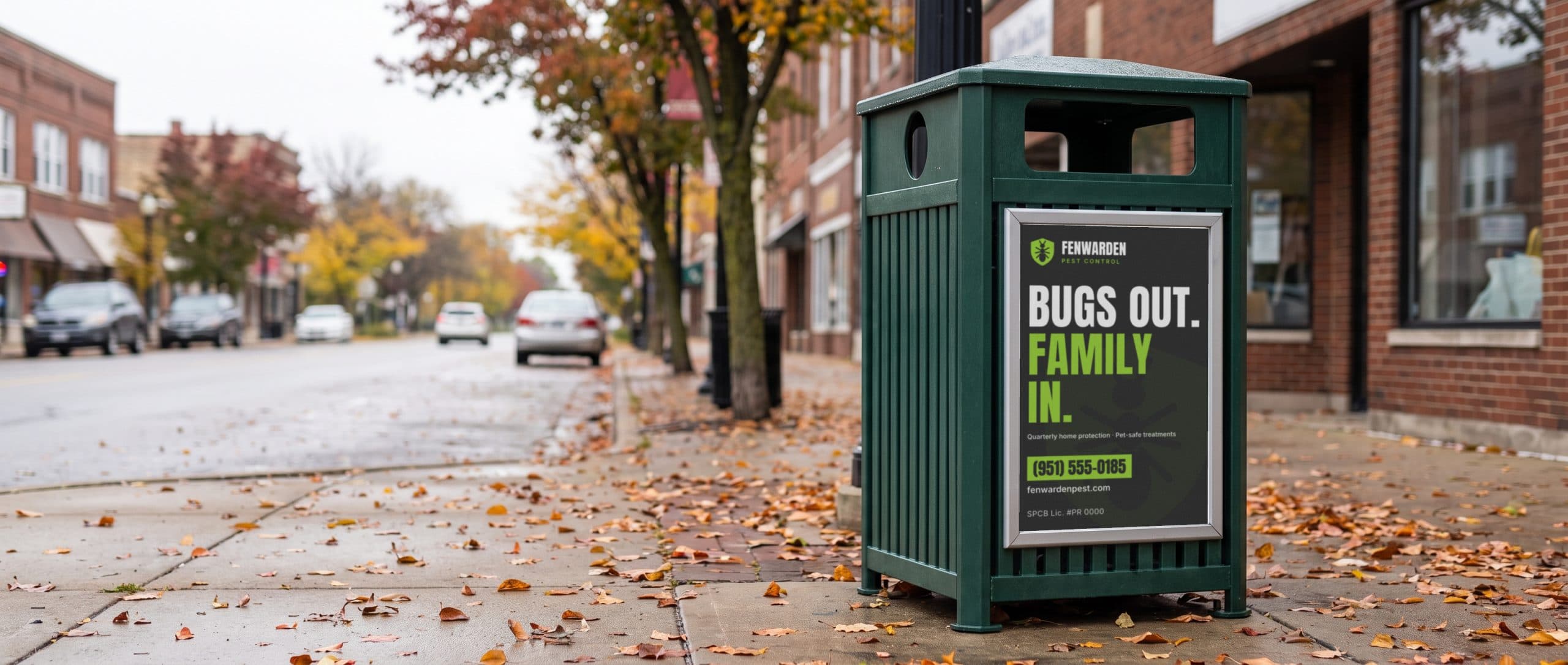
Can you advertise on trash cans?
Yes, in a lot of cities. But the trash can on the corner isn't for rent the way a billboard is. It sits on a public sidewalk, and the city controls that space. So when a public can carries an ad, it's almost always because the city signed a contract with a company.
The deal usually has three sides:
- The city owns the sidewalk and decides whether ads are allowed at all. It writes the rules for what an ad can say.
- The vendor buys, installs and maintains the cans, sometimes empties them too, and gets the right to sell the ad panels.
- The advertiser buys panels from the vendor, the same way you'd buy a bench or a shelter ad.
Why would a city agree to this? Trash cans cost money to buy, place, clean and replace. Ads can pay for that. Vacaville, California says it plainly in its policy: the city accepts advertising to subsidize costs for the placement of outdoor recycling containers. In some deals the city also gets a cut of the ad money.
If you've bought a bench ad, none of this is new. It's the same setup cities use for benches and bus shelters. Read bus bench advertising for that side of street furniture, or bus shelter advertising for shelters.
How city trash can ad programs work
Most contracts cover the same handful of things. When you read a city's staff report, look for these:
- The right to sell ads. Often exclusive for a set area or set of cans.
- What the vendor provides. The cans, installation, cleaning, repair, and sometimes trash pickup.
- What the city gets. Free service, a minimum payment, a share of ad revenue, or a mix.
- The ad policy. What can and can't run, and who reviews it.
- The term. When the deal ends, and whether the city can extend it.
A worked example: York Region, Ontario
York Region's transit staff laid one of these deals out in a May 2007 report. In June 2005 the Region gave Creative Outdoor Advertising the exclusive right to place ad faces on waste-recycling receptacles at bus stops, through November 30, 2010. In exchange, the company provided, at no cost to the Region:
- Scheduled and unscheduled collection and disposal of trash and recycling.
- Cleaning and maintenance of the receptacles.
- At least 400 receptacles over the term of the agreement.
- A minimum monthly payment of $8 per unit or 5% of advertising net revenue, whichever was greater.
A later report that year says about $32,000 was paid to the Region for 2006, which was the 5% share. Staff then planned to fold the receptacles into a larger street furniture contract when the deal ran out.
Not every deal looks the same
Warman, Saskatchewan signed a smaller version in 2023. The city's own release says the same company would supply, install and maintain 14 three-stream receptacles at no cost to taxpayers and sell ad space to local businesses. The city gets 10% of the ad revenue, and city staff empty the receptacles. So the split, and who hauls the trash, changes from deal to deal.
Which cities have sold ads on trash cans?
Here are programs we could confirm on the city's own pages or in its staff reports. Some are old or have ended; the point is how the deals were built, not that each one runs today.
| City | What | Vendor named | City's side | Source |
|---|---|---|---|---|
| Chicago, IL (2012) | Ads on nearly 400 BigBelly cans downtown | Vector Media (one-year deal) | Announced: 50% of any revenue | City press release |
| Philadelphia, PA (2019) | Ads on BigBelly units | Green City Solutions (long-term concession) | 350 new BigBellies plus cleaning | City program page |
| York Region, ON (2005-2010) | Ad faces on bus stop receptacles | Creative Outdoor Advertising | Service plus $8/unit a month or 5% | Staff report |
| Warman, SK (2023) | 14 three-stream receptacles | Creative Outdoor Advertising | 10% of ad revenue | City release |
| Vacaville, CA (2019) | Recycling stations with ads | Creative Outdoor Advertising of America | Council adopted the ad policy and authorized the agreement | City policy |
As stated in each city's own record. Vendors are listed only as those records name them.
Chicago and Philadelphia: ads on solar compactors
Chicago's 2012 plan bundled trash cans with billboards and a recycling sponsorship. The city announced a one-year partnership with Vector Media to sell ads on the BigBelly cans in the Loop, with the city getting 50% of any revenue. Philadelphia went longer. Its BigBelly program page says City Council approved a long-term concession in 2019, and the contractor sells the ads in exchange for buying 350 new BigBellies and cleaning them.
Toronto: bins inside a bigger contract, now coming out
Toronto's street furniture program has about 25,000 pieces, litter bins included, installed and maintained under a 20-year partnership with Astral Media that ends in August 2027. The city says Astral's exclusive ad rights cover select transit shelters and information pillars, and the city gets free installation and maintenance plus a share of the ad revenue. In March 2026 the Executive Committee asked staff to consider a new street furniture contract that leaves litter bins out, and to look at having the city's own waste division run them. The background letter pointed to "broken and overflowing litter bins." Bundling cans into an ad deal is a choice cities revisit.
What can't go on a trash can ad?
A city that sells this space writes down what can run on it. Vacaville's policy is a clear one to read. Its council adopted a Recycling / Solid Waste Management Program Advertising Policy in October 2019, in the same resolution that authorized an agreement with Creative Outdoor Advertising of America.
The policy says the city isn't creating a public forum. It accepts ads only to pay for recycling containers, and keeps strict control over what runs. Ads can't include:
- False, misleading or deceptive statements.
- Defamatory statements, or ones likely to hold a person or group up to scorn or ridicule.
- Obscene or pornographic material.
- Statements that advocate imminent lawlessness or violent action.
- Anything that promotes alcohol, tobacco or cannabis products.
- Religious or political ads, as the policy defines them.
- Intellectual property infringement.
- Unauthorized endorsements, meaning anything implying the city backs a product, service or person.
It also sets the review steps. The contractor screens every ad first. If it's unsure, it sends the ad to the Public Works Superintendent, who decides in writing. An advertiser whose ad is rejected can appeal to the Director of Public Works within 15 calendar days.
Not legal advice
This summarizes one city's published policy. Your city's list will differ. Ask the vendor for the policy that applies to the cans you want before you design anything.
How much does trash can advertising cost?
Hard to say from public numbers, and we won't guess. Most vendors don't publish city trash can rates. Warman's release, for example, tells businesses to call the vendor about rates and availability.
Don't confuse what a city earns with what you'd pay. A 5% or 10% city share tells you how the vendor splits its income. It doesn't tell you the price of a panel.
The one rate card we found is from a college campus, not a city. Lehigh University's facilities office posted these prices for ads on its Big Belly bins:
| Run time | Department rate | Student group rate |
|---|---|---|
| 2 weeks | $30 | $15 |
| 1 month | $50 | $25 |
| 3 months | $85 | $42.50 |
| 6 months | $165 | $82.50 |
Lehigh University, Big Belly side panel advertising pricing, 2019-2020 year. Printing was extra at $30 per ad, with 10-12 business days to mount. A campus program, not a city rate.
Use it as a sense of scale for one bin, nothing more. A city deal is priced by the vendor, usually by how many cans, which areas and how long. Printing the panels is often a separate charge. To compare trash cans with other formats on cost, read outdoor advertising cost.
How to buy an ad on a city trash can
- Find out who holds the contract. Look at a can with an ad on it; the vendor's name or phone number may be on the panel. If not, search your city's site or council records for "receptacle advertising" or "street furniture".
- Call the vendor, not the city. The city usually can't sell you the space. The vendor can.
- Ask which cans are open. Get the locations, how many, and the minimum number of panels or months.
- Ask what's included. Printing, installation, and what happens if a panel is damaged or tagged.
- Ask for the ad policy. Read it before you design. Ask how long review takes.
- Keep the art short. People pass a can on foot or in a car. A name, one line and a phone number is plenty.
- Track it. Put a phone number or web address on the panel that appears nowhere else, and count what comes in.
If your city has no trash can program, a bench or shelter program may be the nearest thing. For a wider list of local options, read how to advertise a small business locally.
Recycling bins, solar compactors and your own cans
"Trash can advertising" covers a few different things. You'll also see it called litter bin or street bin advertising.
- Recycling stations. Two- or three-stream bins for trash, recycling and sometimes organics, with ad panels on the sides. Warman's and Vacaville's programs are this type.
- Solar compactors. Enclosed units such as BigBelly. Philadelphia says they hold almost five times more trash than wire litter baskets and report when they're full. Their flat sides carry ads in some cities.
- Cans you buy yourself. Property owners, malls and campuses can buy receptacles with ad frames. One maker says graphics panels slide into frames on the can and can carry a logo or paid ads. That's your property and your rules, not a city program.
For an advertiser, the first two are bought the same way: through whoever holds the contract. The third is a purchase, not an ad buy.
Trash cans vs garbage truck panels
If a trash can program makes sense to you, the collection trucks are the same idea. The city controls the asset, a company sells the space under a contract, and a written policy decides what can run. The difference is that the can stays on one corner and the truck moves.
| City trash can ad | Garbage truck panel | |
|---|---|---|
| Where it is | One fixed spot on a sidewalk | Trucks rotate through the city's collection routes; no route guarantee |
| Who sells it | The vendor holding the city's contract | The company holding the city's agreement |
| Content rules | The city's written ad policy | The city's written ad policy |
| How you measure it | A tracking number on the panel | A tracking number on the panel |
General comparison. Each city's contract sets the actual terms.
Cities have put ads on their refuse trucks. Columbus, Georgia's council approved a contract for it in 2021. Read can you advertise on garbage trucks? for how that approval worked.
Here's how ours works. Roadway Displays has built sign frames for refuse and recycling trucks since 1987. It's a framed sign, not a wrap. The printed panel slides out of the frame. The panel live area is 91 x 27 in, with two sides per truck. The printed panel swaps in under 30 seconds. A new message still goes through design, review and printing first.
In each city, every ad will be checked against that city's written ad policy before it runs. Refuse trucks are not part of the industry's audited audience ratings (Geopath), so any reach figure we show is labeled as an estimate, with how we got it. There is no Roadway advertiser case study yet. Add a tracking number to your panel and count your own calls. Talk to us for pricing.
No city is open yet. Join the list for your city and we will write when it opens. Learn how garbage truck advertising works, compare it with other truck ads, read the ad policy, or see your ad on a garbage truck.
Sources
- City of Chicago: Mayor Emanuel announces municipal marketing initiatives (press release, Oct 2012)
- City of Philadelphia: BigBelly Program
- City of Toronto: Street Furniture
- City of Toronto: Street furniture and litter bin program update, background file to item 2026.EX29.5 (PDF)
- Regional Municipality of York: transit report, May 31 2007 (PDF)
- Regional Municipality of York: Transit Committee report, Oct 18 2007 (PDF)
- City of Warman: New city partnership increases waste disposal opportunities at no cost (Mar 22 2023, PDF)
- City of Vacaville: Recycling / Solid Waste Management Program Advertising Policy, adopted Oct 22 2019 (PDF)
- Lehigh University (seller): Big Belly side panel advertising pricing, 2019-2020 (PDF)
- Securr (seller): Outdoor trash can / recycle bin with advertising frames, HS245
- Consolidated Government of Columbus, Georgia: council minutes, Apr 13 2021 (Resolution 111-21)
Written by
Roadway Displays
Roadway Ad Network is a business line of Roadway Displays, which has built sign frames for refuse and recycling trucks since 1987. We make the frames and print the panels ourselves.
Published · Updated · About us