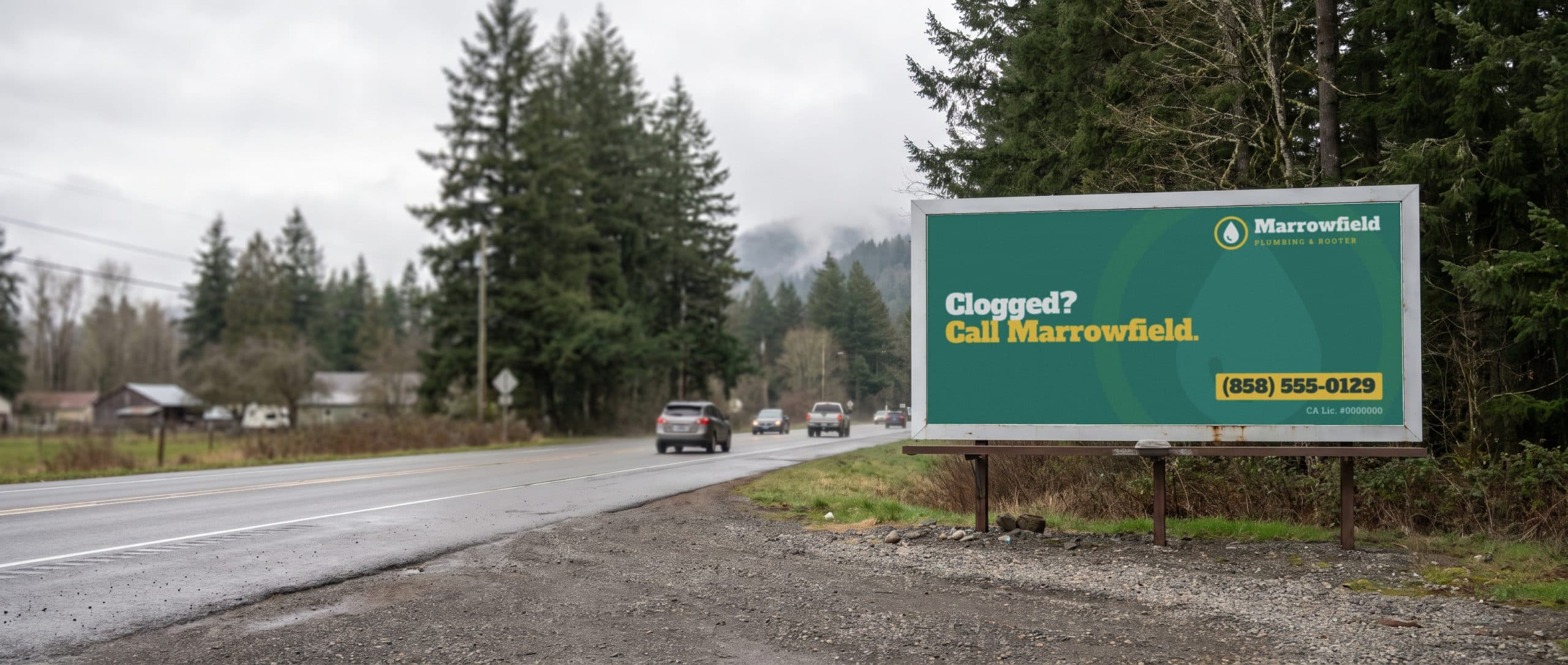
How does billboard rental work?
When you rent a billboard, you rent the ad face for a set time. You don't rent the steel, the land or the lights. The company that owns the sign keeps all of that, and you pay for your message to be on it for a run of dates.
There are really two contracts behind every board. The sign company leases the ground or wall from a property owner, often for 10 to 20 years. Then it rents the face to advertisers on much shorter terms, typically 4-week flights or month-to-month. As an advertiser, you only sign the second one.
The basic unit is one face for one flight. A flight is the run of dates you book. Static boards are typically sold in 4-week posting periods, so when a seller says "per month," they usually mean four weeks, or 28 days. That puts 13 cycles in a year, not 12.
Boards are booked in the order people sign. Blue Line Media, an agency, says advertising is sold on a first come, first served basis, so the board you want may already be taken for your dates. If your start date matters, ask about availability before anything else.
Static and digital boards rent differently. On a static board your vinyl is printed and posted, and it is the only ad on that face for the whole flight. On a digital board you share the screen. Your ad plays for a few seconds, then other ads play, and the loop repeats all day. That difference is why digital can be sold by the day and static usually can't.
Price depends on the market, the board and the length of the run, and printing and posting are billed on top for static boards. We keep the full price ranges on one page: see what a billboard costs.
Who do you rent a billboard from?
You can rent the same board through several doors. Which one you use depends on how many boards you want and how much work you want to do yourself.
- The sign owner. Companies that own and operate boards rent them directly. AdQuick, a marketplace, names Lamar Advertising, Clear Channel Outdoor and OUTFRONT Media as major U.S. operators, and says independent operators hold a large share of boards in smaller markets and rarely publish rates.
- An agency or broker. An outdoor agency asks several sign owners for options and puts them in one proposal. Useful when you want boards in more than one town, or don't know which company owns the board you like.
- An online marketplace. Marketplaces collect boards from many owners so you can search a map and compare. AdQuick says it pulls inventory from Lamar, Clear Channel Outdoor, OUTFRONT and independents.
- A self-serve digital platform. You make an account, pick screens on a map, set a daily budget and upload your ad. Blip lists over 3,500 digital billboards and no minimum spend and no long-term contracts.
Finding billboards for rent near you
Start with the roads, not the companies. Write down the two or three roads your customers drive to reach you, then drive them and note the boards that face traffic heading your way. Ask the sign owners in your area, an agency or a marketplace for open boards near those roads. When you get a list, ask for the exact location, which direction the face reads, its size, and its open dates. Blue Line Media says you can share ZIP codes, addresses, landmarks, commuting routes, or a desired radius and get nearby options with maps.
Can you rent a billboard for a day?
Not a static billboard. Static boards are typically sold in 4-week posting periods. Blue Line Media says some markets may allow shorter terms at a premium, but a printed board still has to be printed, posted and taken down, so one day rarely makes sense.
A one-day billboard is a digital product. Here are the real options, and the shortest booking each one lists.
| Option | Shortest booking listed | How it's priced | Source |
|---|---|---|---|
| Digital billboard through a seller | Often weekly or daily, by market | Share of a rotating loop | Blue Line Media (seller) |
| Self-serve digital platform | As little as a day, no minimum length | Per 8-second play; daily budgets from $20 in some locations | Blip (seller) |
| Personal-message digital board | A single day | Generally $50 to $250 per day | Fliphound (seller) |
| Mobile billboard truck | A day (8-hour minimum at one seller) | $800 to $3,600 per day; $175 an hour at one seller | AdQuick, Billboard Express (seller) |
| Static billboard | Usually four weeks | Per four-week cycle | Blue Line Media (seller) |
Published by each seller or guide; not offers. Availability depends on the market and the dates.
Digital boards
On a roadside digital board, your ad shares the screen. Blue Line Media says a digital board shows a single ad for eight to ten seconds every one to two minutes, with about six to eight advertisers in rotation, and only still images, no video. If the board is open and your file is ready, it says digital can start as soon as same day or next day. Read more about digital billboard advertising.
Self-serve platforms and personal messages
Self-serve platforms let you book screens yourself. Blip says ads run in 8-second rotations, that you pay per play, and that approval typically takes 1-3 business days. So a one-day campaign still needs a few days of lead time. For birthdays, proposals and other personal messages, Fliphound sells days on digital boards and says an ad can go live immediately once the artwork is done.
Mobile billboard trucks
A truck carries your ad to where you want it on the day you pick: an event, a store opening, a trade show. AdQuick puts trucks at $800 to $3,600 per day, and Billboard Express lists $175 an hour with an 8-hour minimum. Our guide to mobile billboard truck rental covers how booking, routes and city rules work.
How long do you have to rent a billboard?
For a static board, plan on four weeks at a minimum and think in four-week blocks after that. A spring promotion might be one cycle. A brand you want people to remember might be three or more.
Longer runs usually cost less per cycle. AdQuick says commitments of 13 weeks or more typically earn 10 to 20 percent off the rate. Its how-to answer adds that longer commitments and off-peak booking windows are the most reliable levers for negotiating a lower rate.
Watch for spending minimums too. Blue Line Media lists a minimum purchase of $5,000 or more per market, which can be spread over displays and periods. That can mean one board for several cycles, or several boards for one. Self-serve digital platforms usually have no minimum, which is why they suit short tests.
If four weeks of one board is more than you want to spend, our guide to cheap billboard advertising lists lower-cost ways onto the road. For a side-by-side of every format, see outdoor advertising cost.
How to rent a billboard, step by step
AdQuick lays out seven steps: define your audience, find inventory, review proposals, compare locations, sign a contract, submit your creative, and launch. Here is what each one looks like for a local business.
- Decide who you want to reach and what they should do. Call, visit, book online. That choice sets the board, the road and the words.
- Pick the roads. List the roads your customers drive, and which direction they travel when they're heading to you.
- Ask for options. Contact the sign owners in your area, an agency or a marketplace. Give them your roads, your dates and your budget.
- Compare proposals. AdQuick says a proposal typically includes pricing, location details, estimated impressions, photos, contract terms, production costs, and posting fees. Collect a few.
- Check the board in person. Drive past it at the time your customers would. Look at how long it's in view and what blocks it.
- Negotiate and sign. Ask about longer runs and open off-peak dates. Read every fee and date before you sign.
- Send your artwork on time. Blue Line Media says static print files are due 2-3 weeks prior to ad start date, and digital files 3 business days prior.
- Get proof it ran. Blue Line Media says it sends installation photos after posting for static boards and flight confirmations for digital. Ask for the same from any seller.
- Count the response. Put a phone number or short web address on the board that you use nowhere else, and count what comes in.
What's in a billboard rental contract?
A billboard contract is short compared with most leases, but it carries the details that decide whether you get what you paid for. This checklist is built on what AdQuick says a contract should specify and what to review before signing. Check each one:
- The board. Exact location, size and format (static or digital). For digital, how long your spot runs and how many ads share the loop.
- The dates. Start and end dates, and any blackout windows when the board isn't yours.
- The price, itemized. The rental rate, plus printing and posting fees listed separately for static boards.
- Deadlines. When the artwork is due, and how long the seller's content approval takes.
- Visibility. Any scheduled maintenance that could take the board down during your flight.
- Ending early. Termination clauses: who can end the contract, and what it costs.
- Proof. A posting photo or a flight confirmation, so you can see the ad ran.
The audience number in a proposal is the seller's estimate. Ask where it comes from, and count your own calls and visits either way.
Not legal advice
This is a checklist from public sources, not legal advice. Read the whole contract, and have a lawyer review it if the amount or the term is large.
How long does it take to get a billboard up?
For a static board, count backward several weeks from your start date. For digital, a few days is often enough. The published timelines vary by seller, so ask yours.
| Step | Static board | Digital board | Source |
|---|---|---|---|
| Artwork due | 2-3 weeks before the start date | 3 business days before the start date | Blue Line Media (seller) |
| Printing and installation | Typically 1 to 3 weeks | None | Blue Line Media (seller) |
| Fastest start | Weeks | As soon as same day or next day, if the board is open | Blue Line Media (seller) |
| Production window, another estimate | 2 to 6 weeks | Within days once creative is approved | AdQuick |
Seller and marketplace estimates, not guarantees. Your seller's deadlines are the ones that count.
Renting vs buying a billboard
Most people who search "buying a billboard" want to buy ad space, which is renting. Buying the sign itself is a different deal. AdQuick calls owning a billboard a real-estate transaction rather than an ad buy: you usually take on the structure, the ground lease and the permit. Building a new digital board, it says, typically costs $100,000 to $500,000+.
In California, running billboards is a regulated business. The Business and Professions Code says a person is in the business of outdoor advertising when they place an advertising display or change its message when the display isn't only about their own business and is visible from a state highway or freeway. That business needs a state license, renewed every year, and each display in the covered areas needs a written permit. Caltrans, which runs the program, also asks for written permission from the local government, such as a building permit, before it issues a state permit.
That is why most businesses rent. The sign company carries the license, the permits and the ground lease, and you carry a message for a few cycles. This is a summary of public sources, not legal advice.
Still deciding whether a board is worth the money at all? Read are billboards worth it, which also covers the states that ban new billboards.
Where garbage truck panels fit
A garbage truck panel is a framed sign on the side of a city refuse truck, not a wrap. We haven't published terms for it, so it isn't in the table above.
The printed panel swaps in under 30 seconds. A new message still goes through design, review and printing first, so plan for it the way you would a static board. In each city, every ad will be checked against that city's written ad policy before it runs.
Talk to us for pricing. No city is open yet. Refuse trucks are not part of the industry's audited audience ratings, so any reach figure we show will be labeled as an estimate. Add a tracking number to your panel and count your own calls, the same as you would on a billboard.
Read how garbage truck advertising works, see your ad on a garbage truck, or join the list for your city.
Sources
- Blue Line Media (seller): Billboard advertising, rates, minimums, deadlines and FAQ
- AdQuick (marketplace, seller): How much does a billboard cost, 2026
- AdQuick (marketplace, seller): How do you rent a billboard?, September 2026
- AdQuick (marketplace, seller): How do billboard advertising contracts work?, September 2026
- Blip (seller): Rent a billboard online, self-serve
- Blip (seller): Pricing
- Fliphound (seller): Digital billboards for personal messaging
- Billboard Express (seller): Mobile billboard cost and rates
- Caltrans: Outdoor Advertising program
- California Business and Professions Code section 5300
- California Business and Professions Code section 5301
- California Business and Professions Code section 5350
- Geopath: Transit FAQs
Written by
Roadway Displays
Roadway Ad Network is a business line of Roadway Displays, which has built sign frames for refuse and recycling trucks since 1987. We make the frames and print the panels ourselves.
Published · Updated · About us