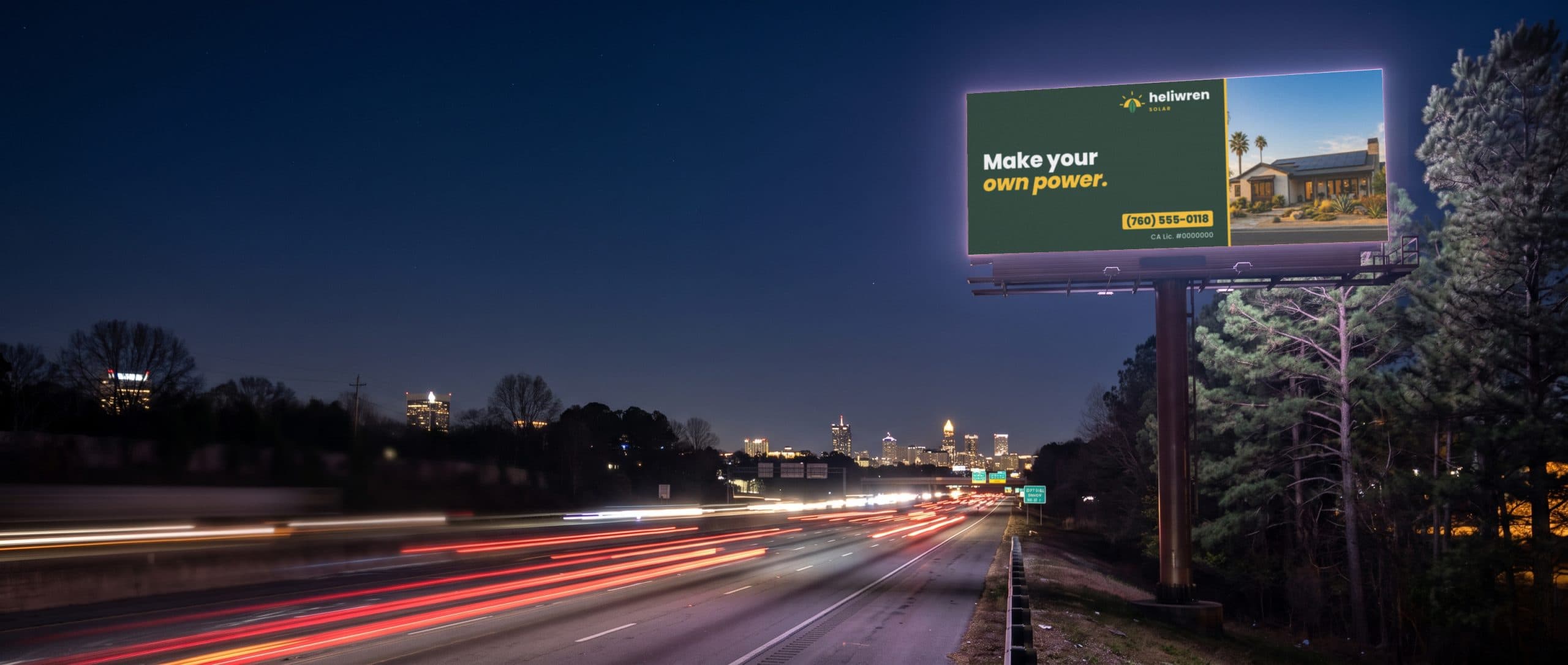
Are digital billboards effective?
Digital billboards can work. Drivers notice them, and people say they act on what they see. But the evidence behind most claims you'll read online is thinner than it looks, and very little of it is about a business your size.
There are three kinds of evidence, and each one measures something different:
- Eye tracking. Researchers put drivers in instrumented cars and record where they look. This tells you whether a screen gets a glance. It says nothing about sales.
- Surveys. People are asked whether they've noticed digital billboards and what they did afterward. Useful, but it's what people remember and report, not a record of what they did.
- Lift studies. Analysts compare outcomes like store visits between people who were likely exposed to ads and people who weren't. These cover many brands at once and are usually paid for by the industry.
None of the three measures one screen, for one local business, in one market. A study across hundreds of national campaigns can show that outdoor ads move people. It can't tell you whether a plumber's 8-second spot on one screen will make the phone ring.
So treat every number below as context, not a forecast. And when a seller or a sign maker quotes a recall rate or a return on investment, ask for the report, the sample size and who paid for it. When we couldn't open the report behind a number, we left the number out.
How do digital billboards work?
A digital billboard is an LED screen built in a standard billboard shape. The OAAA, the out-of-home industry's trade group, defines it as a billboard that can change its content using digital technology, with several advertisers' messages shown in rotation every few seconds. The OAAA's glossary adds that the content is static, meaning each message is a still image.
The screen plays a loop. Each advertiser gets a spot in it, and the loop repeats all day. One sign maker says screens typically show 8-second ads in a loop of 64 or 128 seconds, so an ad comes back every one to two minutes. The seller loads your image remotely. Blue Line Media (seller), an ad agency, says digital art is due 3 business days before the start date, compared with two to three weeks for printed art.
Why still images, and why roughly 8 seconds? Because highway rules set limits.
- California. Business and Professions Code section 5405(d) says a message center display along an interstate or primary highway can't show motion, can't change in intensity, and can't expose its message for less than four seconds. It also can't sit within 1,000 feet of another one on the same side of the highway. Cities and counties may set stricter limits.
- Federal guidance. A Federal Highway Administration report notes that FHWA guidance recommends digital billboards not change content more often than once every 8 seconds.
That's a summary, not legal advice. If you're planning a campaign, the seller is the one who holds the permit and follows the rules. For screen sizes and formats, see types of billboards.
Share of loop: how often your ad actually plays
This is the part most pages skip. On a printed board, your ad is up 100% of the time. On a digital board, you own a slice of the time, and the size of the slice depends on the loop.
The math is simple. Divide your spot length by the loop length to get your share of the screen's time. Divide an hour (3,600 seconds) by the loop length to get how many times your ad plays per hour.
| Spot and loop | Ads in the loop | Your share of screen time | Plays per hour |
|---|---|---|---|
| 8 seconds in a 64-second loop | 8 | 12.5% (one-eighth) | About 56 |
| 8 seconds in a 128-second loop | 16 | 6.25% (one-sixteenth) | About 28 |
| A printed (static) board | 1 | 100% | Always up |
Our arithmetic, using the 64- and 128-second loops one sign maker describes. Real screens vary; ask the seller for the exact loop and spot length, and whether the screen runs all night.
Now think about a driver. If the board is in view for a few seconds as someone drives past, they may catch your spot, or one of the other seven or fifteen. A commuter who passes twice a day for a month will catch it some of the time. That's the trade you make on digital: you share the face with other advertisers in exchange for flexibility.
The audience numbers follow the same logic. Geopath, the industry's audience measurement body, says the share of voice for each spot is one of the inputs it uses to compute impressions. In plain terms, your spot's estimate reflects its share of the loop, not the whole screen's audience. Blindspot, which sells digital billboard time, puts it this way: on a digital loop you buy frequency in a rotation, not exclusivity.
Ask before you buy
How long is the loop? How long is each spot? How many spots are sold right now? Does the screen run 24 hours or shut off overnight? Those four answers tell you what share of the board you're really getting.
How digital billboard time is bought
Digital billboard rental is more flexible than renting a printed board. Static boards usually sell in four-week periods, while Blue Line Media says digital can run weekly or daily depending on the market. There are four common ways to buy. For what each one costs, see digital billboard advertising cost.
- A slot for a flight. You rent one spot in the loop for a set run, often four weeks. Your ad plays every time the loop comes around.
- Per play. Self-serve marketplaces sell open spots one play at a time. Blip prices by the 8-second play, says the price varies by location, time of day and demand, and has no minimum and no contract.
- By the hour. Some sellers let you book by the hour, so a campaign can run only when it matters.
- Dayparting. Running different ads at different times of day, or only at certain hours. The IAB, the digital advertising trade group, lists daypart and schedule among the targeting options digital out-of-home screens support.
Dayparting is the main thing digital can do that print can't. A coffee shop can run mornings only. A restaurant can run a dinner message from 4 to 7. A business closed on Sundays can skip Sundays. None of that is possible on a printed board.
Programmatic digital billboards
Programmatic means buying screen time through software, the way online ads are bought, instead of booking a placement by phone or email. The IAB's definition of digital out-of-home says ads can be planned, bought and sold programmatically through a demand-side platform, though it isn't required. It's a real share of the market: the OAAA reports that digital made up 36% of US out-of-home ad sales in 2025, and programmatic was 30% of that digital spend.
For a small business, programmatic mostly matters through self-serve tools that sell plays directly. Agencies use it to buy many screens across markets at once.
What the studies actually measured
Here are the studies most often behind claims about digital billboards. For each one: who paid for it or published it, what it measured, and what it can't tell you.
| Study | Who paid or published | What it measured | What it can't tell you |
|---|---|---|---|
| Nielsen DOOH report, 2020 | Nielsen. The report doesn't say who paid for it; its photos are credited to the OAAA, and the copy we read is hosted by an outdoor ad company. | 453 online surveys, people 16+ in the top 30 US markets, Feb 24 to Mar 4, 2020. 62% said they noticed a digital billboard in the past month, 38% in the past week. | It's self-reported noticing, in big cities, before the pandemic. Not memory of a specific ad, not sales. |
| OAAA and Kochava, May 2026 | Sponsored by FOARE, the industry's research foundation. Run by the OAAA with analytics firm Kochava. | Device-level data across hundreds of campaigns in seven industries. Median lift of 20% for in-person outcomes and 14% for digital outcomes, against about 10% for connected and broadcast TV. | It covers all out-of-home, not digital billboards alone, and big-brand campaigns, not one local screen. |
| FHWA eye-tracking study, 2012 | Federal Highway Administration, Office of Real Estate Services. | Where drivers looked, in instrumented cars past digital boards, printed boards and roads with none, in Reading, PA and Richmond, VA, day and night. | Attention, not recall or sales. Two cities, 55 drivers in total. |
| Dukic et al., 2013 | Published in Traffic Injury Prevention. Funded by the Swedish Transport Administration, according to a Scenic America release (an anti-billboard advocacy group). | Eye tracking of 41 drivers in instrumented vehicles, passing electronic billboards and other signs. | Gaze and safety, not ad results. 41 drivers in one country. |
Each row links to the page we read. Who paid for a study doesn't make it wrong, but you should know.
The Nielsen report goes one step further than noticing. Of the 279 people who had noticed a digital billboard in the past month, 34% said they had visited an advertiser's website or searched for it online after seeing a digital billboard in the past year, and about a third said they'd visited a store, restaurant or other business. That's encouraging. It's also people's memory of a whole year of billboards, not a count of anyone's visits.
The pattern across all four: digital boards get noticed and get looked at. Whether that turns into calls for you depends on your message, the screen and the hours, which is why your own tracking matters more than any of these.
Do digital billboards distract drivers?
The two best-known eye-tracking studies point in different directions, and both say they aren't the last word.
The FHWA study found drivers spent between 73% and 85% of their visual attention on the road ahead, whether a digital or a printed board was in view, and the digital boards weren't tied to less looking at the road. The longest single fixation on a digital board was 1,335 milliseconds, under the 2,000-millisecond threshold the report links to higher crash risk, though one run of back-to-back looks at a digital board on a freeway went past 2,000 milliseconds. Drivers were generally more likely to look at a digital board than at a printed one. The authors say the study doesn't give definitive answers.
The Swedish study found drivers had longer dwell times, more fixations and longer maximum fixations when passing an electronic billboard than other signs on the same road. Its authors say whether that's a safety hazard can't be answered conclusively from their data.
For an advertiser, both studies agree on the part that matters here: a changing screen draws the eye more than a static sign. Neither measured whether drivers remembered the ad.
Digital billboard vs static: which works better?
Neither one is better across the board. They're different purchases. Our billboard pillar guide covers billboards in general; here's the side-by-side for digital versus traditional billboards.
| Static (printed) billboard | Digital billboard | |
|---|---|---|
| Time on the face | 100%, all day, for the whole run | Your spot's share of the loop |
| Changing the message | New print and install; art due 2 to 3 weeks ahead | Upload a new file; due 3 business days ahead |
| How it's bought | Usually four-week periods | Flights, plays, hours or programmatic |
| Timing by hour | Not possible | Dayparting |
| Audience estimate | The board's full estimate | Based on your spot's share of voice |
How the two formats differ. Prices are on the billboard and digital billboard format pages.
Pick static if you have one steady message and want to own a location. Pick digital if your offer changes, you only care about certain hours, or you want a small test before a longer commitment.
Street-level formats split the same way. A framed printed panel on a city garbage truck is static: one message, up the whole time the truck is out working, not a slice of a loop. No city is open yet. Read how garbage truck advertising works.
How to test a digital billboard yourself
Digital is easier to test than static, because you can start small and change one thing at a time. Set it up before the first play.
- Get the loop facts in writing. Loop length, spot length, how many spots are sold, and the screen's operating hours.
- Ask for a play log. Dates, times and how many times your ad ran. Pay-per-play sellers should be able to show this.
- Give the ad its own phone number or short web address. Every call or visit on it came from the screen.
- Test one thing. Run the same ad in two dayparts, or two offers in the same hours, and compare the response.
- Give it more than a week. A loop builds frequency over time. Judge it on several weeks of tracked calls, not a few days.
Then do the break-even math in our guide to whether billboards are worth it: what you paid, divided by the new customers you can trace to the screen. If the number holds up, scale it. If it doesn't, you've learned that cheaply. To compare formats, see types of billboards, billboard truck rental for LED trucks, or see your ad on a garbage truck.
Sources
- OAAA: OOH glossary of terms (digital billboard)
- LED Sign City (seller): Typical cost of advertising on billboards (spot and loop length)
- California Business and Professions Code section 5405 (message center displays)
- Federal Highway Administration: Driver Visual Behavior in the Presence of Commercial Electronic Variable Message Signs (CEVMS), Sept 2012 (FHWA-HEP-16-036)
- Dukic, Ahlstrom, Patten, Kettwich and Kircher: Effects of Electronic Billboards on Driver Distraction, Traffic Injury Prevention 14(5), 2013 (TRID record)
- Scenic America (advocacy group): press release on the Swedish study, Jan 3 2013 (PDF)
- Nielsen: Digital Out-of-Home Advertising Report 2020, Top 30 Markets (hosted by Meadow Outdoor, PDF)
- OAAA: OOH delivers 2x the performance lift of TV, OAAA and Kochava study (May 2026; sponsored by FOARE)
- OAAA: 2025 OOH Facts & Figures, Ad Spend Performance (PDF)
- Geopath: High-Level Media Measurement Process
- IAB: Digital Out-of-Home (DOOH) Definition and Core Features, Dec 2024 (PDF)
- Blip (seller): Digital billboard pricing
- Blindspot (seller): How much does a billboard cost (updated July 2026)
- Blue Line Media (seller): Billboard advertising
Written by
Roadway Displays
Roadway Ad Network is a business line of Roadway Displays, which has built sign frames for refuse and recycling trucks since 1987. We make the frames and print the panels ourselves.
Published · Updated · About us